

Utah's Spookiest Story? Skinwalker Ranch
A bulletproof wolf. Vanishing dogs. A calf emptied in broad daylight. And a Pentagon program whose investigators say something followed them home. This Halloween, a case that a remote ranch in the Uintah Basin may be the most unsettling story Utah has ever told.
The case for Utah's spookiest story
Every state has its ghost stories. Utah has a ranch the federal government paid to investigate.
This summer the History Channel aired the seventh season of The Secret of Skinwalker Ranch. Viewers who stuck with it, this writer included, came away the way they usually do: intrigued, a little frustrated, and no closer to an answer. The team drilled, scanned, launched rockets and set off fireballs. The ranch, as usual, kept its secrets.
But the show was never the scariest part. The scariest part is what happened on that land before the cameras arrived, as told by the family who fled it, the scientists who studied it, and a Pentagon official who says it changed his life. Read those accounts back to back, in October, with the lights off, and a claim starts to feel reasonable: Skinwalker Ranch may be the spookiest story in Utah.
A note before we begin. Nothing below has been proven. These are accounts from witnesses and investigators, most of them published in two books by Las Vegas journalist George Knapp and his co-authors. Many reach us secondhand, retold across books, interviews and articles over nearly three decades, and details sometimes vary from one telling to the next. We present them as what they are: some of the strangest stories ever told about a piece of Utah ground.
The Sherman years: the wolf that wouldn't fall
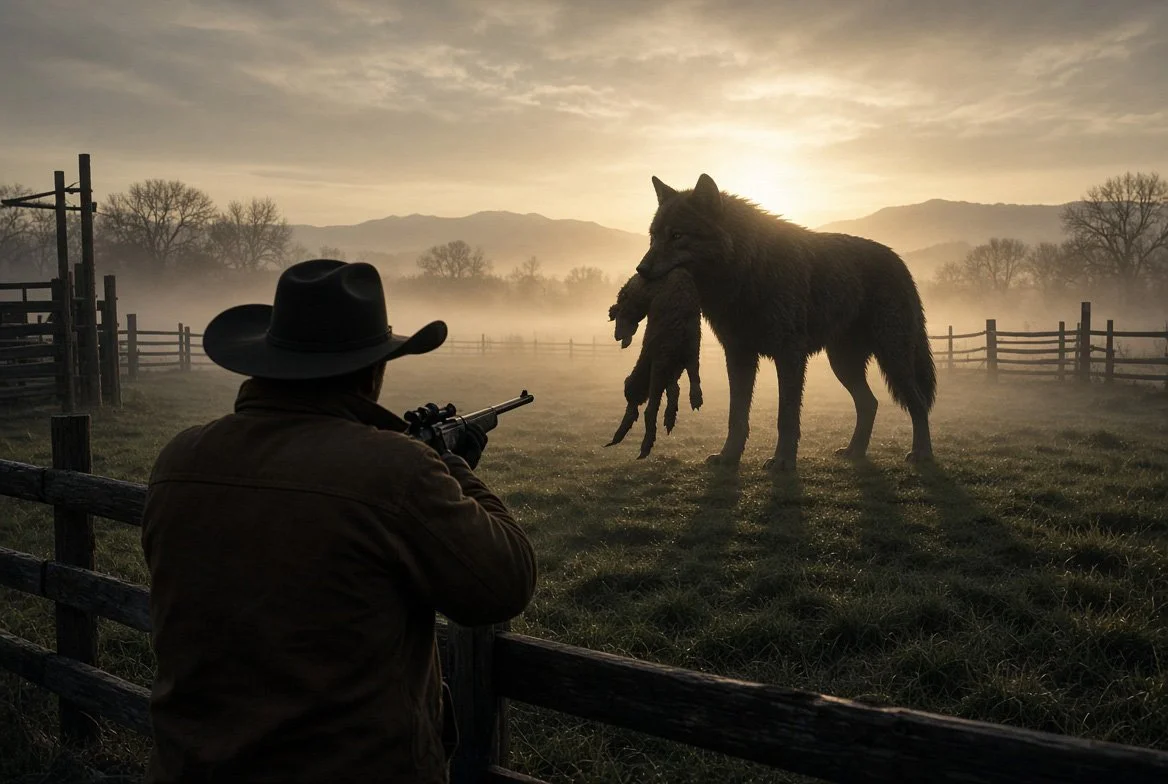
Shortly after moving onto the ranch in 1994, Terry Sherman said he shot an oversized wolf at close range as it seized a calf. By his account, the animal never went down.
AI-generated illustration based on an account in Hunt for the Skinwalker (2005). Not a photograph.
In 1994, Terry and Gwen Sherman bought a ranch southeast of Ballard in Uintah County, hoping to raise cattle. In Hunt for the Skinwalker (2005), the family appears under the name "Gorman."
The first story is the one that gave the place its reputation. Shortly after moving in, the family saw an enormous wolf in the pasture, by their account roughly three times the size of a normal wolf. It seized a calf. Terry Sherman shot it at close range with a rifle, then again, and again. The animal never went down. It eventually left on its own.
It got worse from there:
The dogs. By the family's account, Terry watched his three dogs chase a glowing orb into the brush one night. He heard them yelp, then nothing. He didn't follow. In the morning, the dogs were gone, and accounts of the story describe scorched circles in the grass where he last heard them.
The cattle. Cows turned up dead and mutilated. The family told the Deseret News in 1996 about one found with a strange hole in its eye and no trace of blood.
The lights. The Shermans reported lights on the horizon, circles pressed into their fields, and voices speaking an unknown language from no visible source.
The family lasted about 18 months. In 1996 they sold the ranch to Las Vegas businessman Robert Bigelow, who wanted scientists to see it for themselves.
The NIDS years: scientists in the dark
Bigelow installed his National Institute for Discovery Science on the property in 1996. The team included biochemist Colm Kelleher, who later co-wrote Hunt for the Skinwalker with Knapp. They came with cameras, instruments and a skeptic's checklist. Within days, the ranch tested it.
The calf. On the morning of March 10, 1997, the ranch manager and his wife tagged a newborn calf, about 84 pounds. Their dog began acting strangely. When they went back roughly 45 minutes later, in broad daylight, they found the calf with its body cavity emptied. Kelleher later pointed out what bothered everyone most: an animal that size should have left blood everywhere. It hadn't.
The eyes in the tree. Two nights later, on March 12, Kelleher and the team spotted something in a tree about 50 yards away, perched some 20 feet off the ground. All they could make out was a pair of unblinking yellow eyes staring back into their light. A shot was fired. The thing was gone.
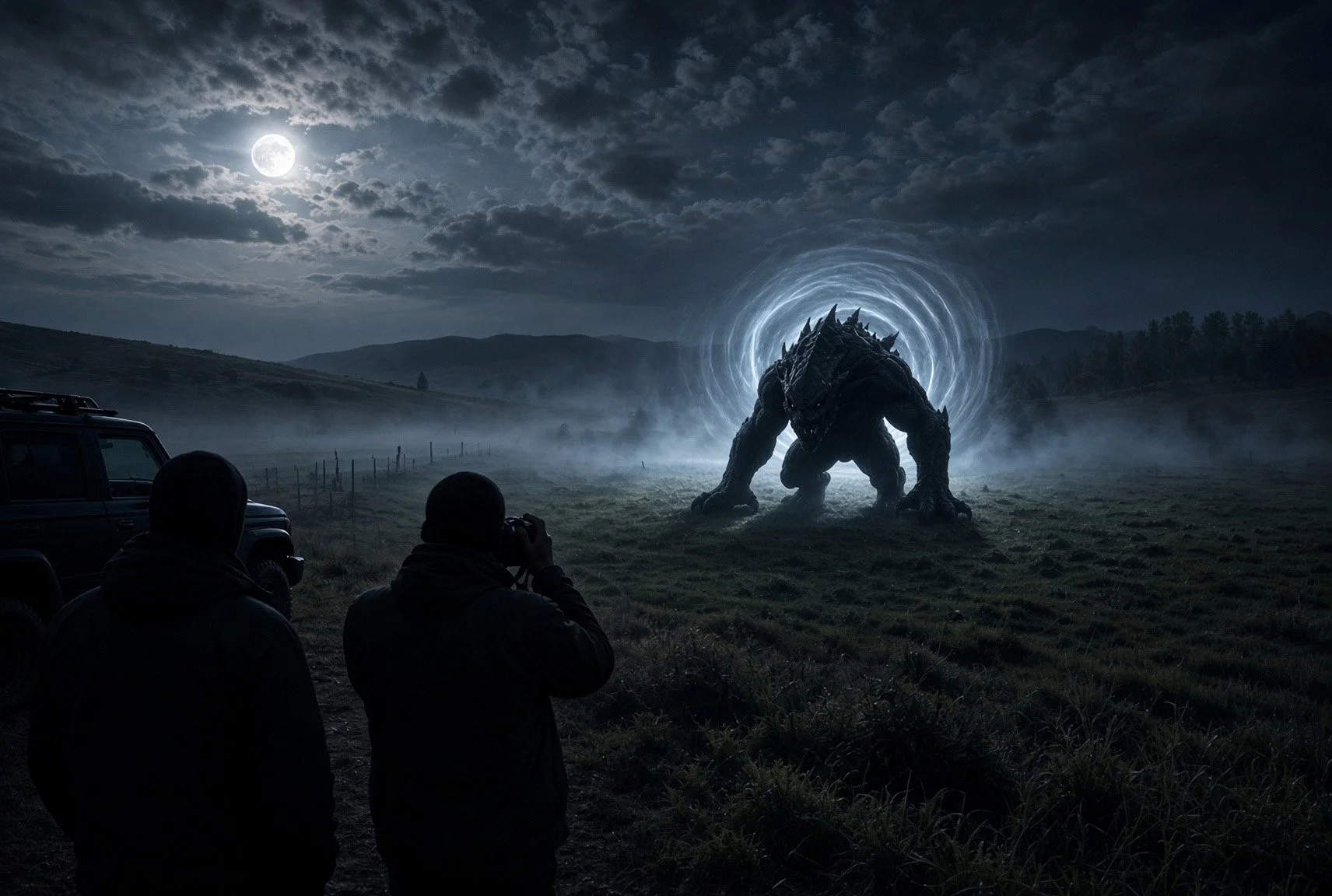
AI-generated illustration based on an account in Hunt for the Skinwalker (2005).
The tunnel of light. The most famous NIDS account came later that year. As told in the book, two investigators watching a pasture at night saw a dim light take on depth until it looked like a tunnel. Something large and dark crawled out of it, dropped to the ground and moved off into the night. Then the light closed.
NIDS stayed until 2004. Publicly, at least, the team never produced the clean, repeatable proof science demands, and Kelleher has said the activity seemed to fade after 2000.
That "publicly" matters. Much of what was gathered on this ranch has never been released, including some of what was collected in those early years. The Pentagon-funded program that followed produced reports of its own, and the copies that have surfaced are heavily redacted. One leaked 2009 progress report described the ranch as a possible laboratory for studying "other intelligences." Another said investigators were attempting to communicate with a non-human entity they believed was there. Even this year's Pentagon file releases have not included a ranch-specific assessment. So when anyone says nothing was ever found at Skinwalker Ranch, the honest reply is: nothing we've been allowed to see.
The Pentagon years: what followed them home
The ranch's second act is stranger, because it involves the U.S. government.
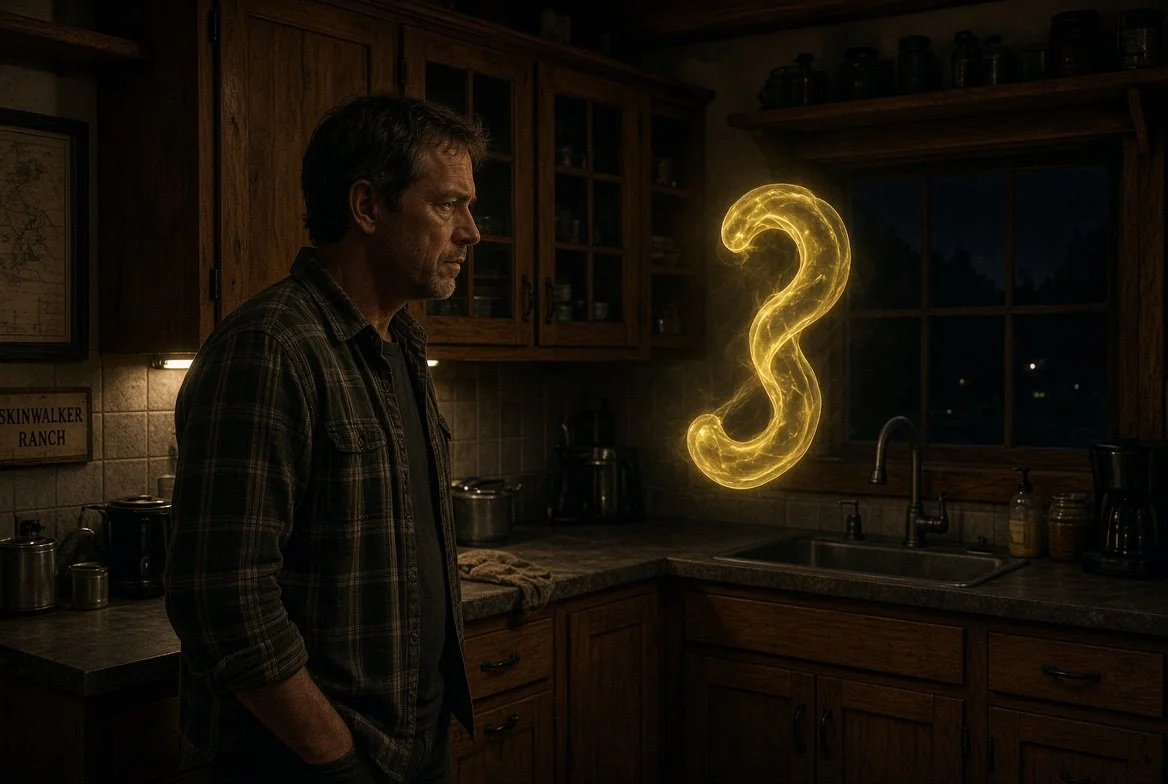
AI-generated illustration based on an account in Skinwalkers at the Pentagon (2021). Figure is not a likeness of any real person. Not a photograph.
In July 2007, James Lacatski, a rocket scientist with the Defense Intelligence Agency, visited the ranch with Bigelow. According to Skinwalkers at the Pentagon (2021), which Lacatski co-wrote with Kelleher and Knapp, he stood in the kitchen of a ranch house and watched a yellowish, tubular object take shape in the air a few feet away. It hovered for perhaps half a minute and vanished. He said nothing at the time. Months later, a Pentagon program funded with $22 million was studying the ranch.
That program's investigators brought home the story that may be the most chilling of all. The book calls it the hitchhiker effect: the claim that whatever is on the ranch can follow visitors back to their own houses.
The accounts read like a Halloween campfire tale, except the people telling them held security clearances. One official's family reported large dog-like animals in the backyard and blue spheres floating in their sons' bedrooms. Others described dark, shadowy figures standing over their beds at night, and objects moving on their own. Kelleher has since written about the effect as if it spreads like a contagion, passing from visitors to their families.
On the current show, some cast members say they avoid talking about the hitchhiker effect at all, half-joking that saying its name might invite it. Owner Brandon Fugal has said he knows of it but hasn't experienced it himself.
A word about the name
"Skinwalker" is not a Halloween costume. It comes from Navajo tradition, where it refers to something many Navajo people would rather not discuss at all, let alone see on a TV title card. The ranch itself sits next to the Uintah and Ouray Reservation of the Ute Tribe, some 400 miles north of the Navajo Nation. Accounts in the books describe longstanding Ute wariness of the land.
It's worth holding that respect alongside the fun of a good scare. The stories in this piece belong to ranchers, scientists and officials who say they experienced them. The word belongs to someone else.
Seven seasons later
Which brings us back to this summer's TV season. Season 7 gave viewers more of what the show does best and worst: impressive equipment, UAP footage, experts watching their gear fail in ways they'd never seen, and a finale that mostly recapped what came before. Even Utah Governor Spencer Cox stopped by, telling the team that nearly everyone in the area has a Skinwalker story. A Season 8 is widely expected but, as of this writing, not officially announced.
For all the radar, lasers and drilling, nothing on screen has matched the old accounts: a wolf that shrugged off rifle rounds, three dogs that never came home, a calf emptied in under an hour in daylight, and government investigators who say the ranch followed them home to Washington.
Maybe there's an explanation for all of it. Maybe a hoax, a misreading, a story that grew in the telling. But on a dark October night, with the wind moving across the sage flats out past Ballard, it's hard to think of another Utah story that gets under the skin quite like this one.
Sweet dreams, Wasatch Front.
Utah's Other Spooky Tales
Skinwalker Ranch isn't the only Utah story that will keep you up tonight. Four honorable mentions, three of them an easy drive from the Wasatch Front.
The Bear Lake Monster (Rich County). In July 1868, Joseph C. Rich wrote to the Deseret News that settlers had seen a huge serpent-like creature in Bear Lake, building on an older Native legend of a "water devil." Salt Lake buzzed. Brigham Young reportedly sent a rope to Paris, Idaho, to help capture it. About 26 years later, Rich admitted the whole thing was a hoax. Sightings kept coming anyway, and the monster now has its own winter festival.
The Purple Lady (Rio Grande Depot, Salt Lake City). The depot at 300 South Rio Grande Street opened in 1910 and today houses state history offices. Staff, security guards and former café workers have reported footsteps on the empty mezzanine, flickering lights and a sorrowful woman in a purple dress. The legend says she died on the tracks chasing an engagement ring her fiancé had thrown there.
Union Station (Ogden). Ogden's old rail hub has seen fire, wartime grief and the 1944 Bagley train wreck, when victims were brought to the station. Museum staff say a ghost they call Frank is their most active visitor, and a lady in blue appears more rarely. The station runs paranormal tours each October.
"Victim of the Beast 666" (Salt Lake City Cemetery). One of the most visited graves in Utah's largest cemetery belongs to Lilly E. Gray, who died of natural causes in 1958. Her headstone carries that chilling line: "Victim of the Beast 666." The likely explanation is almost stranger: her husband, Elmer, who had spent time in the Utah State Prison and believed officials were persecuting him, ordered the marker. The "beast," by most accounts, was the government.
Verdict: Bear Lake has the longest pedigree and the Purple Lady the best love story. But none of them came with a federal research budget.
Related: Are We Alone? The View From Utah