

Are We Alone? The View From Utah

The Pentagon released the videos. Congress held the hearings. The History Channel built a hit show around it. And somehow, more often than not, the conversation about whether we are alone in the universe keeps coming back to a stretch of high desert in northeastern Utah.
On Tuesday, May 19, the History Channel will premiere the seventh season of The Secret of Skinwalker Ranch. The promotional tagline that has been running across cable spots and streaming previews for the last several weeks is unusually direct for a network that traffics in mystery: Are we alone in the universe?
It is a question that has, over the last decade, traveled an unusual journey. From the fringe of supermarket tabloids and late-night radio, it has moved to the front page of the New York Times, to congressional committee rooms, to Pentagon press briefings, to the offices of United States senators. The cultural posture toward the subject has shifted. The eye-rolling has not entirely stopped, but it has quieted.
What has not quieted is Utah's place in the conversation. The state — and one ranch in particular — keeps showing up. To anyone who has followed the topic for any length of time, this is not exactly news. To anyone who has not, it deserves an explanation.
Why Utah?
The answer is layered, and it is the reason this magazine is writing this story now. Geography is part of it. So is history — Utah's documented record of unexplained sightings goes back further than most realize. Commerce and media are part of it: the most ambitious privately funded investigation of the phenomenon in American history is happening here, on land owned by a Utah real estate executive, and the most-watched television series on the subject is filmed two and a half hours east of Salt Lake City. And there is one more thread, less often discussed, that runs underneath all of these: the dominant religious tradition in this state has, for nearly two centuries, taught that the universe contains inhabited worlds beyond Earth. That fact does not prove anything. But it shapes the cultural soil in which this conversation grows.
This is the story of why the question of whether we are alone keeps finding its way to Utah.
The Basin
The Uintah Basin sits in the northeastern corner of the state, bordered by the Uinta Mountains to the north and the Tavaputs Plateau to the south. It is high desert, sparsely populated, with sweeping sage flats and skies that on most nights are dark enough to see the Milky Way. The largest towns are Vernal and Roosevelt. The basin's economy has historically run on oil and gas, ranching, and a small but steady tourism flow built around dinosaur fossils and the surrounding wilderness.
It is also, by some accounts, the single most active region for reported unidentified aerial phenomena in the continental United States. Locals have a name for it. They call it UFO Alley.
The reporting record stretches back well into the mid-twentieth century. In the 1960s, a Roosevelt schoolteacher named Joseph "Junior" Hicks began systematically documenting reports from his neighbors — sightings of unusual lights, objects, and craft over the basin. He logged hundreds of accounts over the following decades, and his work attracted the attention of Frank B. Salisbury, a respected plant scientist at Utah State University who had already published in mainstream peer-reviewed journals on a range of subjects. Salisbury found the consistency and credibility of the basin reports striking enough to write a book about them. The Utah UFO Display: A Biologist's Report was published in 1974 and remains the foundational documentary work on the region.
What Salisbury and Hicks documented was not a handful of dramatic incidents. It was a pattern. Sightings of glowing objects, silent craft, and lights performing maneuvers inconsistent with known aircraft, reported by ranchers, schoolteachers, oil workers, and law enforcement, sustained across years. Some of the reports were possibly misidentifications. Some could have been hoaxes. But after applying the filters a serious investigator applies — multiple witnesses, corroborating physical evidence, witnesses with no apparent motive to fabricate — a substantial residue remained.
That residue is what made the basin a topic of interest to people with the resources to investigate it further. By the early 1990s, the most active concentration of reports was on a single property at the eastern edge of the basin, owned at the time by the Sherman family. Strange events on the Sherman ranch — unusual animal mutilations, anomalous lights, encounters that defied easy explanation — eventually drew the attention of an investigative reporter named George Knapp, then of KLAS-TV in Las Vegas, and a Las Vegas businessman named Robert Bigelow.
What followed turned a regional phenomenon into a national story.
The Bigelow Era
In 1995, Las Vegas businessman Robert Bigelow had founded a private research organization called the National Institute for Discovery Science, or NIDS, to investigate anomalous phenomena. In 1996, after reading reporting in the Deseret News by Zack Van Eyck on the Sherman family's experiences, Bigelow purchased the ranch and installed his NIDS team on the property. The investigation ran from 1996 through 2004. It was a private effort, funded entirely out of Bigelow's own pocket, with a team that included scientists, biologists, engineers, and several investigators with academic and government credentials. NIDS shut down in October 2004.
What NIDS produced during that period is partly public, partly not. The scientists involved have spoken on record over the years about the difficulty of getting consistent, repeatable data on phenomena that, by their nature, did not seem to want to cooperate with the scientific method. Knapp and his collaborator Colm Kelleher, the NIDS lead investigator, published much of the NIDS-era account in their 2005 book Hunt for the Skinwalker, which has remained the canonical reference on the property for two decades.
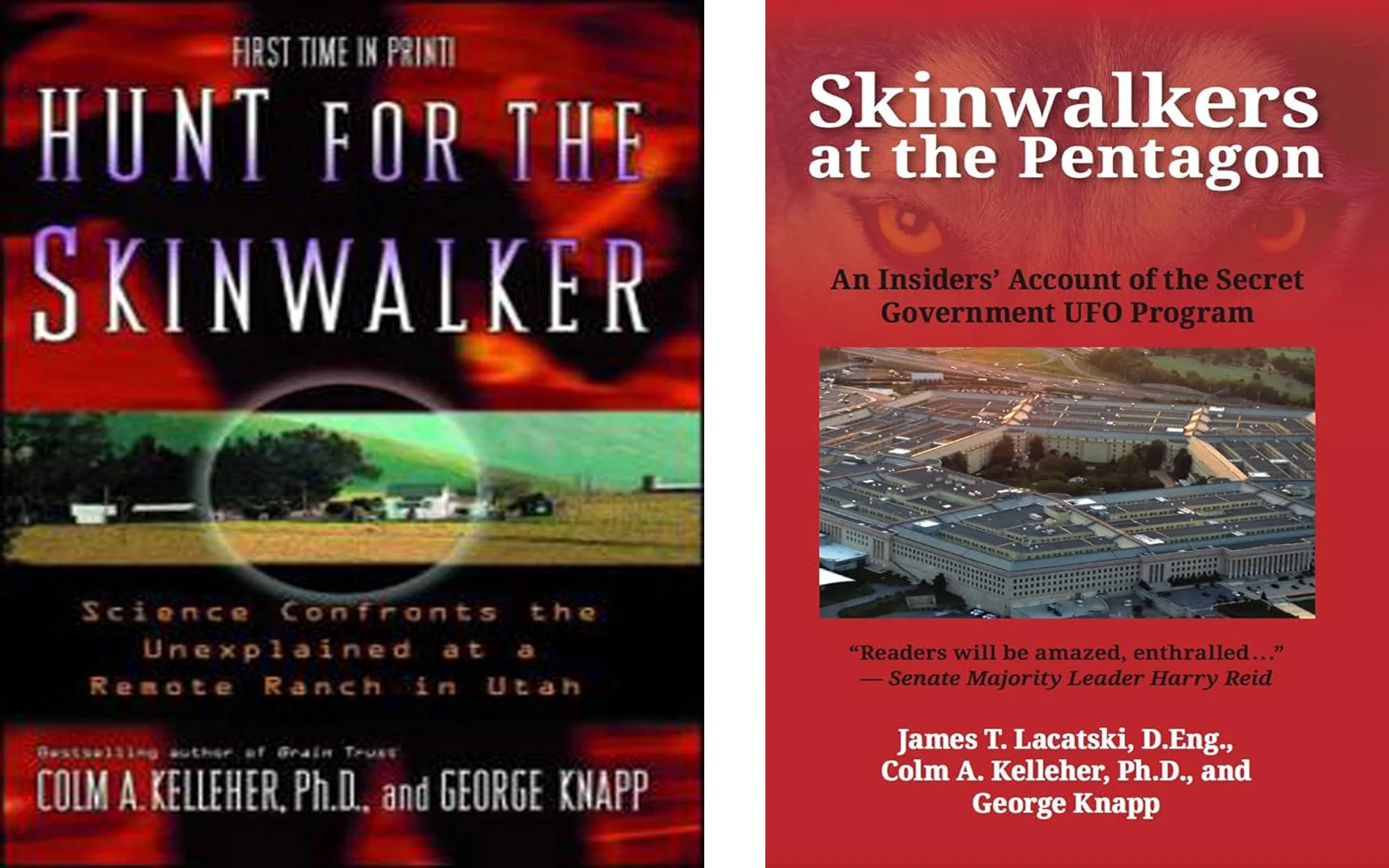
Two Very Popular Books on Skinwalker Ranch
Hunt For The Skinwalker published in 2005. Skinwalkers at the Pentagon was another book published in 2021.
The story did not end when NIDS did. In 2007, a Defense Intelligence Agency rocket scientist named James Lacatski read Hunt for the Skinwalker and became interested in the ranch. He visited the property, had a personal experience there, and brought the matter to the attention of Senator Harry Reid of Nevada — a longtime friend of Bigelow's who had followed the NIDS work closely for years. Reid, working with colleagues in the Senate including Ted Stevens and Daniel Inouye, arranged for $22 million in Department of Defense funding for a new program: the Advanced Aerospace Weapon System Applications Program, or AAWSAP. The contract went to a different Bigelow company — Bigelow Aerospace Advanced Space Studies, or BAASS — which assembled a team of roughly 75 investigators. BAASS conducted on-site work at Skinwalker Ranch and other locations from 2008 through 2010. A related program, the Advanced Aerospace Threat Identification Program, or AATIP, continued related work through 2012.
When the Pentagon funding ended, Bigelow continued some private investigation on the property for several more years before selling the ranch in 2016.
For most of this period, the existence of the AAWSAP and AATIP programs was not publicly known. That changed in December 2017, when the New York Times published a story by Helene Cooper, Ralph Blumenthal, and Leslie Kean reporting the existence of the previously secret Pentagon office. The article disclosed the $22 million in funding, named Senator Reid as the figure who had pushed for the program's creation, identified Bigelow's company as the contractor, and confirmed that the work had included investigations at Skinwalker Ranch. A 2021 follow-up book, Skinwalkers at the Pentagon, written by Kelleher, Knapp, and Lacatski, extended the public account further.
That sequence — the secret Pentagon program, the public revelation, the explicit connection to a remote ranch in northeastern Utah — is what changed the conversation.
Brandon Fugal
In 2016, Bigelow sold the ranch. The buyer was a Utah-based commercial real estate executive named Brandon Fugal, the chairman of Colliers International in Utah and one of the most successful commercial brokers in the Mountain West. Fugal had no public history with the subject. He was, by most accounts, a skeptic. He bought the property quietly, kept his ownership private for several years, and eventually agreed to allow a documentary crew on site.
The result became The Secret of Skinwalker Ranch, which premiered on the History Channel in March 2020. The series follows Fugal, principal investigator Erik Bard, aerospace engineer Travis Taylor, and a rotating team of scientists, military veterans, and specialists as they conduct on-site experiments and investigations. Six seasons have aired. Season 7 begins May 19.
What has set the show apart from a long tradition of paranormal television is the production posture. The team uses radar, instruments, controlled experiments, and rigorous documentation. The investigations are filmed largely in real time. The participants do not pretend to know what they are dealing with. They report what they observe, test what they can test, and acknowledge what they cannot explain. Fugal has stated repeatedly in public interviews — including extended sit-downs with Joe Rogan, Jesse Michels, and others — that the experiences he and his team have documented on the property changed him from a skeptic into someone who believes that something genuinely unexplained is taking place there.
The show has been the most-watched non-scripted series in the History Channel's recent history. It has spawned a spinoff series, Beyond Skinwalker Ranch, and has built a sustained audience that crosses political and cultural lines. It is, in commercial terms, a rare phenomenon: a serious-toned program about an unserious-sounding subject that has found a wide, durable audience.
What Season 7 will reveal is, as of this writing, only partly disclosed. History Channel previews have indicated that the team has expanded its instrumentation, including with the deployment of a dedicated satellite asset, RanchSat-1, designed to monitor the property from low Earth orbit. The season tagline — Are we alone in the universe? — is the most explicit framing the show has used.
The Federal Conversation
Skinwalker Ranch is not the only reason the UAP conversation has changed. It is one of several pressure points.
In April 2020, the Department of Defense formally released three videos taken by Navy aircraft showing objects that the Navy could not identify. The videos — informally known as Tic Tac, Gimbal, and Go Fast — had been circulating in unofficial form for several years, but the Pentagon's formal release was an institutional acknowledgment that the recordings were authentic and that the Navy did not have an explanation for what they showed.
In June 2021, the Office of the Director of National Intelligence delivered a preliminary report to Congress on unidentified aerial phenomena. The report, made public, examined 144 incidents reported by U.S. military personnel between 2004 and 2021. It concluded that the incidents could not be explained by any single cause and that some of the observed behaviors — sustained high-speed flight, abrupt acceleration, the absence of visible propulsion — could not be reconciled with any known aircraft, American or foreign.
In July 2023, the House Oversight Committee held a public hearing on the subject. Three witnesses testified: two Navy pilots with firsthand encounter accounts, and former Air Force intelligence officer David Grusch. Grusch's testimony made headlines. He told the committee, under oath, that the United States government was in possession of recovered non-human craft and biological remains, and that he had been retaliated against for attempting to bring information about the program through proper whistleblower channels. He described disclosure as an "ontological shock" that would, he believed, ultimately unite humanity.
His specific claims have not been independently verified. They have also not been refuted. The Department of Defense has acknowledged Grusch's status as a former intelligence officer of standing and has declined to confirm or deny the substance of his testimony. The All-domain Anomaly Resolution Office, established in 2022 to centralize Pentagon investigation of UAP, has continued to issue periodic public reports.
In November 2024, a second congressional hearing brought additional witnesses and produced additional on-record testimony. The conversation, in 2026, is no longer whether the topic is worth discussing in serious institutional settings. It is.
Why Utah Stays at the Center
Against this national backdrop — federal acknowledgment, congressional testimony, a sustained public conversation — Utah's role has not diminished. If anything, it has clarified.
Skinwalker Ranch remains the most studied piece of land in the entire phenomenon. The Uintah Basin remains the most reported region in the continental United States for sightings. Brandon Fugal lives in Utah, runs his business out of Utah, and has made the ranch the centerpiece of his public profile. The most successful television franchise on the subject is filmed in Utah. The investigators most associated with the modern phenomenon — Knapp, who did his foundational reporting from neighboring Nevada; Lacatski, who managed the Pentagon program from Washington; Fugal, who lives an hour from the ranch — have an unusual concentration of geographic ties to the Mountain West and to Utah specifically.
There is also the cultural dimension. The Church of Jesus Christ of Latter-day Saints, headquartered in Salt Lake City, is the only major American faith whose founding scriptures explicitly describe inhabited worlds beyond Earth. Latter-day Saint scripture and leader teachings, going back to the 1830s, have addressed the question of life beyond Earth with a directness that no other major American religious tradition matches. The accompanying sidebar to this article addresses that history in detail. It does not prove anything about the phenomenon. But it shapes a state in which the question of whether we are alone has never been a culturally radical one to ask.
What this combination produces is a region in which the conversation about extraterrestrial life is, to a degree unusual in American life, simply normal. People in Vernal and Roosevelt have been reporting strange things in their skies for seventy years. The local newspapers have covered it without flinching. The state's largest religious institution has framed the cosmos as populated since before Utah was a state. The most significant private and public investigations of the phenomenon have, by accident or by something else, gravitated to the same stretch of high desert.
That is not a coincidence the size of one ranch. That is something larger.
What Happens Next
Season 7 of The Secret of Skinwalker Ranch will begin airing two weeks from the publication of this article. By the time it concludes later this year, the federal conversation will likely have advanced further. AARO will publish additional reports. There may or may not be additional congressional hearings. The question Grusch asked the committee to take seriously — whether the United States government is in possession of materials that did not come from this Earth — will continue to wait for the kind of resolution that satisfies the standards of evidence the country has always claimed to honor.
What seems certain is that the conversation is not going away. It is not retreating to the fringes from which it once came. The combination of pressures — federal disclosure, public interest, new generations of researchers willing to engage the topic seriously, and ongoing investigation in places like Skinwalker Ranch — has built a momentum that, by the look of it, is still building.
If and when something larger breaks, Utah will not be a bystander to it. Utah will be in the middle of it. The state has been in the middle of it for longer than most people realize, and the structural reasons for that — geographic, historical, commercial, cultural — are not going to change because the news cycle does.
The question that the History Channel is asking on May 19 — Are we alone in the universe? — has been asked in this state for a very long time, by quiet observers logging sightings at kitchen tables, by religious leaders in books and sermons, by ranchers staring up at skies they did not understand, by scientists with instruments they hoped might capture what their eyes could not.
The answer, if it ever comes, will arrive somewhere. There are reasons to believe it might arrive here first.
There are also reasons to believe it might arrive sooner than most expect. In February, President Trump issued a directive on Truth Social calling for transparency around "alien and extraterrestrial life, unidentified aerial phenomena (UAP), and unidentified flying objects (UFOs)." At a Turning Point USA event in Phoenix in April, he told supporters that "the first releases will begin very, very soon." Earlier this month, at the White House, he told reporters the Pentagon is preparing to release "very interesting" UFO files. AARO has confirmed it is working in close coordination with the White House to release "never-before-seen UAP information." Whether any of that produces the deeper facts or visual evidence the public has been promised remains to be seen. But the signals, after decades of silence, are unmistakable.
And one final piece of the cultural moment. Steven Spielberg's Disclosure Day — his first film about extraterrestrial visitation since Close Encounters of the Third Kind nearly fifty years ago — opens in IMAX on June 12. The film's official tagline poses a question directly to the viewer: If you found out we weren't alone, if someone showed you, proved it to you, would that frighten you?
It is a question worth asking. And on May 19, when Season 7 of The Secret of Skinwalker Ranch begins, a small team of investigators in northeastern Utah will be doing what they have been doing for six years now — trying to answer it.
It's Been Said Disclosure Could Destroy Religion — But Would It Really?
For sixty-six years, the conventional wisdom has been that the discovery of extraterrestrial life would shake the world's religions to their foundations. The world's religions, it turns out, mostly disagree.
In 1960, NASA commissioned a now-famous report from the Brookings Institution on the implications of peaceful space activities. Buried in its pages was a warning that has shaped the conversation ever since. The discovery of intelligent life beyond Earth, the report concluded, would be "electrifying" for the world's religions — and potentially "especially damaging" to them.
Sixty-three years later, retired Air Force intelligence officer David Grusch sat before the House Oversight Committee and described the disclosure of extraterrestrial life as an "ontological shock" that would, in his telling, force humanity to reconsider its place in the cosmos. The phrase has been repeated in nearly every major article on the subject since.
There is one obvious problem with this framing. Almost no one making the argument has bothered to ask the world's religions what they actually teach. When you do, a different picture emerges — one in which the major faiths have been thinking about this for centuries, sometimes for two thousand years, and in which their theological frameworks would be challenged by disclosure but, in nearly every case, not destroyed.
Here is where the major traditions, in order of size, actually stand.
Christianity (~2.4 billion)
Christianity is the largest religious tradition on Earth and the most internally varied on the question of life beyond it.
Catholic. The Vatican Observatory, founded in 1891, is one of the oldest astronomical research institutions in the world. In 2008, its then-director Father José Gabriel Funes argued that intelligent extraterrestrial life would not contradict Catholic faith because limits cannot be placed on God's creative freedom. The following year, the Observatory hosted a five-day astrobiology conference at the Vatican. Brother Guy Consolmagno, the Jesuit astronomer who has directed the Observatory since 2015, has gone further: in a 2005 book published by the Catholic Truth Society, Intelligent Life in the Universe?, and across years of subsequent interviews, Consolmagno has said it is only a matter of time before extraterrestrial life is discovered, and that the Catholic intellectual tradition would have no theological problem with it. The harder questions — original sin across worlds, the meaning of incarnation if other intelligent beings exist — have been worked on by Catholic theologians since Nicholas of Cusa in the fifteenth century. Open questions, but not new ones.
Protestant and Evangelical. The picture is divided. By the nineteenth century, Protestant theologians like Thomas Chalmers were openly suggesting Christ's redemption might extend to other worlds. Billy Graham told interviewers he believed intelligent beings existed in distant space who worshiped God. But Pew Research Center polling shows white evangelical Protestants are markedly less likely than other Christians to believe in extraterrestrial life. The most theologically conservative Protestants tend toward the view that scripture's silence on the subject is itself the answer. This is the corner of the Christian world where the Brookings concern lands hardest — a theology built on a strictly literal reading of Genesis would face real friction with disclosure.
Latter-day Saint. No Christian tradition has a more developed framework for inhabited worlds. The Book of Moses, part of the Pearl of Great Price, describes God creating "worlds without number" (Moses 1:33). Doctrine and Covenants 76:24 teaches that the inhabitants of those worlds are "begotten sons and daughters unto God." Joseph Fielding Smith, the church's tenth president, wrote that members have "brothers and sisters on other earths." Spencer W. Kimball, the twelfth president, was direct: "Are planets out in space inhabited by intelligent creatures? Without doubt." No church president has issued an official prophetic declaration on extraterrestrials, but disclosure would not contradict the framework. It would confirm it.
Islam (~1.9 billion)
Quran 42:29 speaks of the creation of the heavens and the earth, and "all living beings He dispersed throughout both." The Arabic word dabbah — generally understood to mean corporeal, sentient creatures — has been the subject of centuries of scholarly commentary. Quran 65:12 describes seven heavens "and of the earth the like thereof," which Ibn Abbas, a companion of the Prophet, interpreted as describing multiple inhabited earths each with their own prophets. The 2024 academic volume Islamic Theology and Extraterrestrial Life concludes that no Islamic teaching forbids belief in extraterrestrial life, and that several scriptural passages strongly suggest its possibility.
Hinduism (~1.2 billion)
The Vedic scriptures describe a universe populated with countless categories of beings across countless realms. Religious scholar David Weintraub has observed that Hindus would likely embrace the discovery of extraterrestrials with little more than curiosity about where the new beings fit within the existing cosmic hierarchy. The framework already accommodates the answer.
Buddhism (~500 million)
Buddhist cosmology may be the most extravagantly populated of any major faith. The Anguttara Nikaya, one of the oldest collections of the Buddha's discourses, describes a universe of thousands of suns and thousands of inhabited worlds. The Dalai Lama, asked about extraterrestrial visitors, has said that should they arrive, they would simply be other sentient beings, treated with the respect owed to any being capable of suffering and awakening. The theological adjustment required by disclosure may be effectively zero.
Judaism (~15 million)
Rabbi Chasdai Crescas addressed the question of multiple worlds in fourteenth-century Spain. The eighteenth-century kabbalist Rabbi Pinchas Eliyahu Horowitz argued in Sefer HaBris that the universe likely contained intelligent life beyond Earth. In the twentieth century, Rabbi Aryeh Kaplan — both a rabbi and a trained physicist — drew on these earlier authorities to suggest intelligent life could indeed exist elsewhere. The traditional Jewish view, broadly, is that life elsewhere expands rather than contradicts the picture of God's creation.
What This Adds Up To
The picture across the traditions is a spectrum, not a single verdict. Buddhism and Hinduism would barely flinch. Judaism, the Catholic Church, the Latter-day Saint tradition, and most of Islam have frameworks ready for the news, with theological work still to do — much of it work they have already begun. The corner where the Brookings concern lands hardest is fundamentalist and biblically literalist Protestantism, where strict scriptural readings would face real adjustment.
Some religious frameworks would be challenged. None of them would be destroyed. The framing of disclosure as a civilizational reset for faith owes more to a particular mid-twentieth-century imagination — one that saw religion as fragile and science as inevitable — than to a serious reading of what the religions themselves actually teach.