

Utah Enters Extreme Drought — What Wasatch Residents Need to Know
Something changed dramatically in Utah last week — and state officials want residents to pay attention.
According to the U.S. Drought Monitor's April 3 report, extreme drought or worse now covers nearly 60 percent of Utah. One week earlier, that figure was just 7 percent. The speed of the change alarmed even seasoned water scientists.
"It's rare to see the drought status over the whole state essentially change by one category in one drought update," said Glen Merrill, a hydrologist with the National Weather Service.
The Snowpack That Wasn't
The crisis traces directly to this winter's historic snowpack failure.
The Utah Division of Water Resources confirmed in its March 2026 Water Conditions Update that Utah's snowpack peaked on March 9 at just 8.4 inches of snow water equivalent — roughly half the amount the state typically accumulates by early April. That peak arrived three weeks ahead of schedule, and forecasters say snowmelt will outpace any new snow the state receives.
It is the lowest snowpack on record in the modern data collection era.
Thirty percent of Utah's SNOTEL monitoring network reported its worst or second-worst snowpack reading on record. This winter was also the warmest in state history, beating the previous record by 2.2 degrees Fahrenheit in a dataset that extends back to 1874. Salt Lake City alone exceeded its previous winter temperature record by more than 7 degrees.
Ninety-five percent of Utah's water supply comes from snowpack. When the mountains don't hold water through winter and spring, there is no recovery mechanism.
What This Means for the Wasatch Front
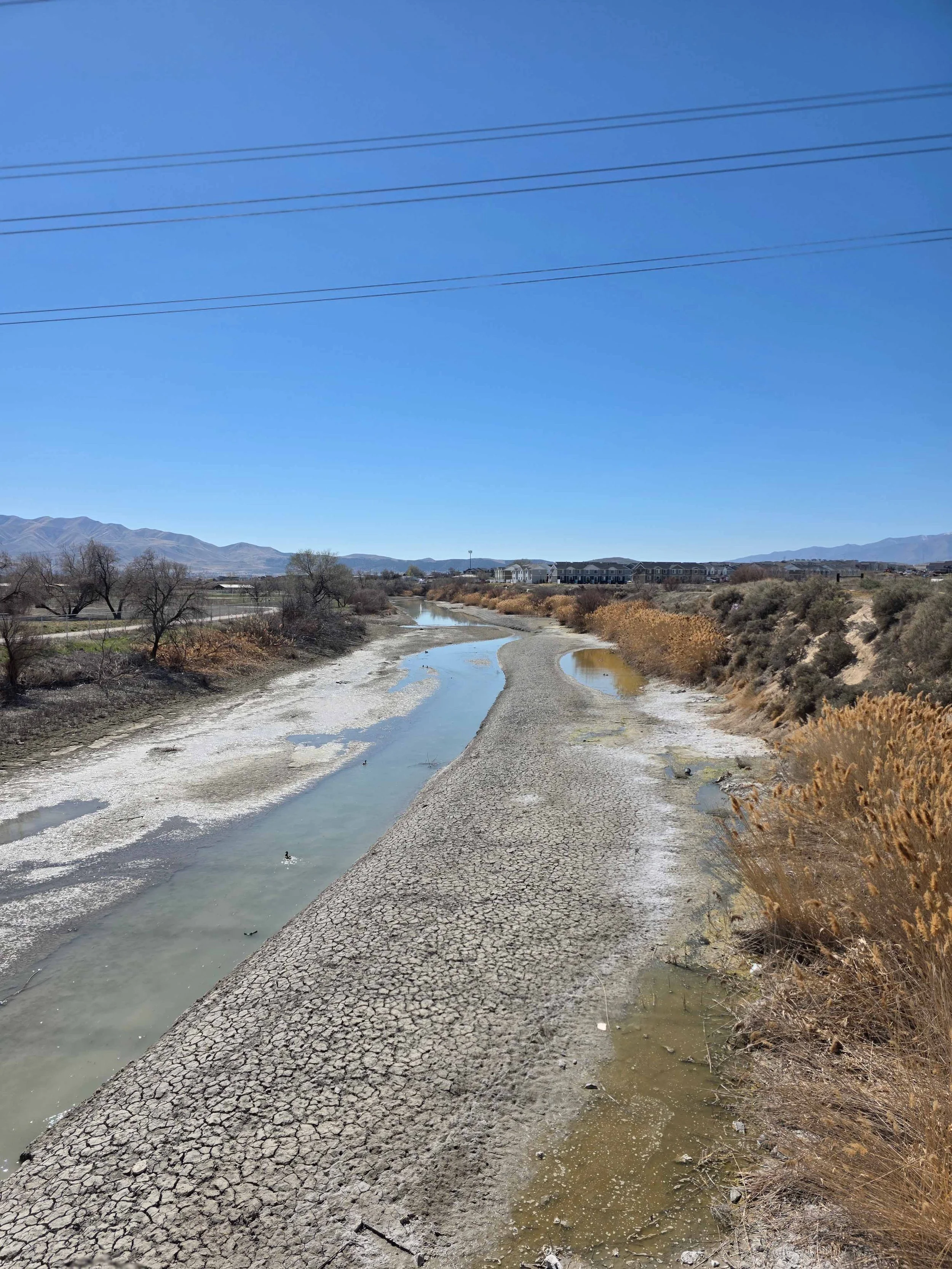
Jordan River Trail, mid-March 2026. Peak runoff season — without the runoff. Photo: Mountain & Main
Reservoir storage across the state currently averages 68 percent of capacity — slightly above normal for this time of year, but down from 80 percent recorded at the same point last year, according to the Division of Water Resources. That buffer is what water managers will draw from through the summer.
The state's drought coordinator, Laura Haskell of the Utah Division of Water Resources, issued a direct call to action in the March update.
"We are urging our communities and local water providers to review drought contingency plans," Haskell said. "These plans will provide clarity and actions to assist with slowing the impacts of drought."
Some communities are already responding. Salt Lake City has enacted a water shortage plan. Wildfire risk is elevated across the state as dry vegetation and record warmth combine heading into Utah's typical fire season.
The National Weather Service's Climate Prediction Center indicates slightly higher odds for above-average precipitation through mid-April, which would provide some relief. However, the agency also projects that below-normal precipitation is likely for Utah throughout April and the following three months — meaning the drought could intensify before it improves.
What You Can Do Now
The Utah Division of Water Resources continues to direct residents to SlowtheFlow.org for practical water conservation resources, including indoor and outdoor water-saving tips, rebate programs, and county-by-county watering guides.
Joel Williams, interim director of the Utah Division of Water Resources, offered a straightforward framing in January, before conditions worsened further: "In Utah, we are either in drought or preparing for the next one. We can all see that our water situation is not looking great."
That statement has proven more accurate with each passing week.
Research compiled with AI assistance. All sources independently verified by Mountain & Main editorial staff.
SOURCES
Utah Division of Water Resources — Utah Water Conditions Update, March 19, 2026 https://water.utah.gov/utah-water-conditions-update-march-2026/
Utah Division of Water Resources — Utah Water Conditions Update, January 22, 2026 https://water.utah.gov/utah-water-conditions-update-january-2026/
U.S. Drought Monitor — Utah State Drought Monitor, April 3, 2026 https://droughtmonitor.unl.edu/CurrentMap/StateDroughtMonitor.aspx?UT