

The Aesthetic Economy Along The Wasatch
How the Wasatch Front Became One of America's
Most Powerful Beauty Markets
By Cal Tebbs
It's easy to drive past another med spa on Bangerter Highway or State Street and think nothing of it. There's another one. What you may not realize is that you're looking at one of the fastest-growing business categories in the country — and that Utah sits at the center of it in ways that would surprise most people.
The Wasatch Front has quietly become one of the most significant aesthetic medicine markets in the United States. Not by accident. Not purely by culture. But by a convergence of geography, demographics, entrepreneurial energy, and — increasingly — a national reputation for quality that is drawing patients here from across the country.
This is a business story. And it's a big one.
Second Only to Miami
When people think of plastic surgery capitals, they think Beverly Hills. Miami. Manhattan. What they rarely picture is Salt Lake City. The data tells a different story.
Salt Lake City ranks second in the United States for plastic surgeons per capita — behind only Miami, and ahead of Los Angeles. Utah has 56 active members of the American Society of Plastic Surgeons, ranking the state 10th nationally per adult population. And when it comes to consumer demand, Utah leads the nation in Google searches for breast augmentation and ranks in the top ten for nearly every other cosmetic procedure search category. The market is real, it is deep, and it is growing.
Steven Williams, a board-certified plastic surgeon and past president of the American Society of Plastic Surgeons, put it plainly: "People always think of New York, Florida, California. But when you look at it per capita, Utah also ranks relatively strongly." That's an understatement.
A Destination Market in Its Own Right
What's changed in recent years is that Utah's aesthetics industry has evolved beyond serving its own population. The Wasatch Front is now a bona fide destination surgery market — drawing patients from Idaho, Nevada, Wyoming, Colorado, Arizona, and beyond, specifically to have procedures done here.
Multiple SLC-area practices have built formal out-of-state patient programs, complete with virtual consultations, coordinated hotel partnerships, extended post-operative recovery accommodations, and dedicated patient coordinators who manage the logistics from initial inquiry to final follow-up. Clinics in Draper — just thirty minutes from Salt Lake City International Airport — market their location as a geographic advantage for traveling patients and advertise savings of up to 20% compared to major metro markets, without compromising on quality or board-certified credentials.
The economics make sense. Utah's cost structure for running a high-quality practice is lower than California, Florida, or New York, while the clinical talent and board certification rates are competitive with any market in the country. That combination — quality parity at a pricing advantage — is exactly what drives destination medicine, and Utah has it.
Dr. Jay Agarwal, a plastic surgeon and professor at the University of Utah's Division of Plastic and Reconstructive Surgery, confirms that out-of-state patients are a regular part of his practice — a pattern he sees across the local market. His read on the underlying draw: Utahns are active, outdoorsy, and health-conscious. They want to look the way they feel. That ethos travels, and it attracts patients who share it.

The Med Spa Explosion
If surgical practices represent the established foundation of Utah's aesthetic economy, medical spas are the growth engine — and the numbers at both the national and local level are staggering.
In 2010, there were approximately 1,600 medical spas operating in the United States. By 2022 that number had grown to nearly 9,000, and industry projections place it at over 11,500 by 2025. Revenue has kept pace, expanding from $1.1 billion in 2010 to an estimated $17.5 billion by 2022 — a more than fifteenfold increase in twelve years. The global medical spa market, valued at roughly $21 billion in 2024, is projected to reach nearly $90 billion by 2034.
These are not niche numbers. This is a mainstream industry.
At the individual business level, the model has proven remarkably profitable. Single-location med spas now average $1.8 to $2 million in annual revenue, with profit margins running 20 to 25% — and high-performing operations reaching 30 to 40%. For context, those margins outperform most retail, restaurant, and service businesses by a significant margin.
Utah matches the national growth trajectory — and in many corridors of the Wasatch Front, exceeds it. The past several years have seen record numbers of med spas and cosmetic clinics open along the I-15 corridor and into the suburban communities of Salt Lake, Utah, and Davis counties. The procedures driving that growth are predominantly minimally invasive: Botox and other neuromodulators, dermal fillers, laser treatments, microneedling, and chemical peels. Facial injectables alone account for nearly half of all med spa revenues nationwide. Shorter recovery times, lower price points, and increasing social normalization have made these treatments broadly accessible — and broadly sought after.
Utah Is Setting the Trends, Not Just Following Them
Perhaps the most underappreciated dimension of Utah's role in the aesthetics industry is that the state isn't simply consuming national beauty trends. It's originating them.
The "clean-girl aesthetic" — polished, natural, seemingly effortless — has been identified by national researchers and beauty industry observers as a Utah export. The look emphasizes subtle enhancements over dramatic transformation: smaller, more proportional breast augmentations; refined facial work that doesn't announce itself; skin that looks healthy rather than treated. Utah-based board-certified surgeons have noted that procedures and techniques developed here have made their way into practices across the country. The Wasatch Front has become, in the language of the industry, a trendsetter market.
That distinction matters economically. Markets that lead on aesthetics tend to attract the most skilled practitioners, the earliest adopters of new technology, and the highest-value patients. Utah's position as both a sophisticated consumer market and a clinical innovator reinforces its appeal as a destination — and continues to fuel the growth of its home-based practices.
The GLP-1 Wave
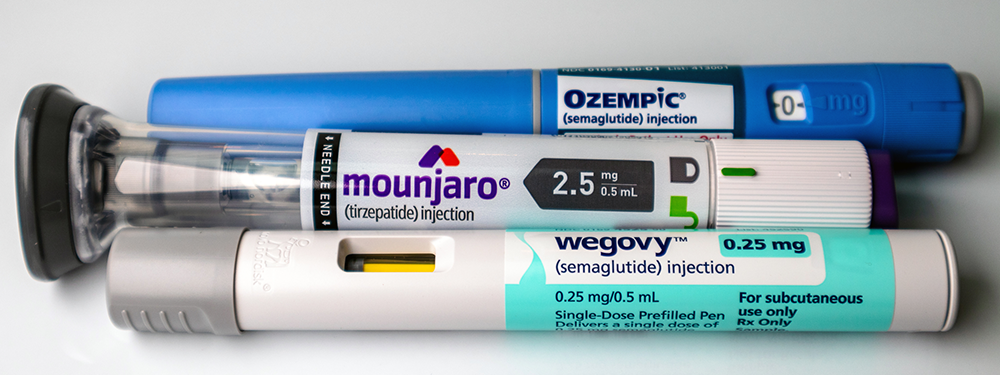
The aesthetics industry is in the early stages of absorbing what may be its most significant demand surge in decades: the body contouring boom driven by GLP-1 weight-loss medications like Ozempic and Wegovy.
These medications have delivered dramatic weight loss results for millions of Americans. They have also left many of those patients with significant skin laxity — loose skin on the abdomen, arms, thighs, neck, and face that diet and exercise cannot address. The result is a new and growing category of patients seeking surgical finishing work: tummy tucks, arm lifts, thigh lifts, lower body lifts, breast lifts, and facelifts to match their new silhouettes. The American Society of Plastic Surgeons confirmed that body contouring procedures saw the highest growth of any surgical category in 2024, with thigh and buttock lifts up 3% and arm and neck lifts up 2% — increases attributed directly to the GLP-1 wave.
For Utah's aesthetics market — already serving a young, active, health-conscious population that has widely adopted these medications — this demand surge is landing on well-prepared ground. Practices across the Wasatch Front are reporting increased consultations for post-weight-loss body work, and the pipeline shows no signs of leveling off.
An Industry Built for What Utah Already Is
There is an environmental dimension to this story that rarely gets mentioned in the business coverage.
UV radiation increases roughly 8 to 10% for every 1,000 feet of elevation. Salt Lake City, sitting at 4,300 feet, experiences approximately 36% more UV exposure than coastal cities — exposure compounded by low humidity and Utah's famously abundant sunshine. The same outdoor lifestyle that defines life along the Wasatch Front accelerates skin aging in measurable ways. The result is a population that is simultaneously active and health-focused, and that faces above-average environmental wear. Skin treatments, sun damage correction, and preventive aesthetic care are not luxury indulgences in this market. For many patients, they are part of a wellness routine that fits naturally alongside the skiing, hiking, and running that characterize life here.
The aesthetics industry, in other words, is built for exactly the population Utah has.
What It Means for the Wasatch Front
The story of Utah's aesthetic economy is still being written. The destination surgery market is maturing. The med spa sector is in full expansion. New demand from the GLP-1 generation is arriving. And Utah's position as both a clinical innovator and a trend-setting consumer market continues to strengthen its draw for out-of-state patients and top-tier practitioners alike.
For communities along the Wasatch Front, this translates into real economic activity — high-paying medical jobs, thriving small and mid-size businesses, commercial real estate demand, and a growing reputation that attracts both patients and entrepreneurs from outside the region.
It may not be the first industry that comes to mind when you think about the economic fabric of this corridor. But in 2026, it belongs in the conversation.
This article was developed with AI-assisted research. All data points have been verified against primary sources including the American Society of Plastic Surgeons, the American Med Spa Association, and Utah State University's Utah Women & Leadership Project.
Sources: American Society of Plastic Surgeons 2024 Procedural Statistics Report · USU Utah Women & Leadership Project, "Cosmetic Surgery and Body Image Among Utah Women: A 2025 Update" · American Med Spa Association 2024 State of the Industry Report · Fox 13 News investigative reporting, 2024 · University of Utah Health, Division of Plastic & Reconstructive Surgery