

Utah Is Becoming A Major Sports Market – Now Comes the Hard Part
The Big League Wasatch
By Cal Tebbs | Utah Sports Ink
Updated Tuesday, April 14, 2026
At a Glance
- The Utah Mammoth sold out all 41 home games in their inaugural NHL season — before most fans had even heard the name
- The Jazz are deep in a full tear-down rebuild, and their fans are still showing up and filling the Delta Center
- Salt Lake City is widely considered the frontrunner for one of two MLB expansion slots, backed by a $3.5 billion stadium proposal
- BYU and Utah now compete as Power Four rivals in the same conference — and both ranked entering their 2025 football showdown
- SUU's Flippin' Birds gymnastics program is heading to the Pac-12, the Flippin' Birds were built over 34 years by Coach Scott Bauman in Cedar City
- Two Utah ownership groups now control five major professional franchises — a remarkable footprint for a market this size
By the time Ryan Smith looked out at a sellout crowd on opening night last fall and thanked them for "packin' the barn," the question was no longer whether Utah could support major league hockey. It had already been answered. The Utah Hockey Club — now the Utah Mammoth — sold out every one of its 41 home games in its inaugural 2024-25 season and helped push NHL attendance to a record 23 million tickets for the third straight year. Players who had just relocated from Phoenix were stunned by the warmth of the reception. Defenseman Nick DeSimone told reporters it already felt like "hockey's been here for a while."
It had not, of course. The NHL franchise had been in Utah for less than six months when the puck dropped on opening night. But the reception said something important about a market that the broader sports world is only beginning to take seriously: the Wasatch Front is ready.
The question now isn't whether Utah is a sports town. It is. The question is how big it intends to get, how fast, and whether the market's depth can match its ambition.
The Franchise That Changed Everything
The arrival of professional hockey — by way of the collapsed Arizona Coyotes — was the single most dramatic proof of concept this market has ever produced. A new NHL team, with six months of runway, landed in Salt Lake City and immediately became a civic event.
The numbers were striking. Season tickets sold out before a puck had been dropped. The team's obstructed-view strategy — offering seats behind the goal for $10 a ticket, bundled with a hot dog and a bottled water — was widely praised as one of the most effective grassroots fan acquisition moves in recent hockey memory. A Deseret News/Hinckley Institute poll conducted during the inaugural season found that roughly a quarter of all Utahns were closely following the team. The youngest adults, ages 18 to 35, showed the highest engagement at 31 percent.
The team finished seven points short of the playoffs in Year One, but no one who had been watching considered the season a disappointment. The 2024-25 Mammoth improved by 12 points over what that same roster had managed in Arizona the season before. Clayton Keller, named the franchise's first-ever captain, had a career year with 90 points in 81 games. Forwards Logan Cooley and Dylan Guenther and defenseman Michael Kesselring were among the team's representatives selected for international competition following the season.
What Utah built in that first season was not a championship team. It built something harder to manufacture: a fan base that showed up even when the team didn’t win, and left wanting more.
What Utah built in that first season was not a championship team. It built something harder to manufacture: a fan base that showed up even when the team didn't win, and left wanting more.
The story ahead is also significant. The Delta Center, which the Mammoth share with the Jazz, holds only about 11,000 fans for hockey — among the smallest footprints in the NHL. Plans are underway to expand capacity to 17,000 within three years. The team was officially renamed the Utah Mammoth following a fan vote, with the permanent identity revealed in May 2025. And the franchise's arrival comes with a 2027 marquee event: the NHL's Winter Classic — the league's signature outdoor game — is scheduled for Rice-Eccles Stadium. Utah's sports stage just keeps getting larger.
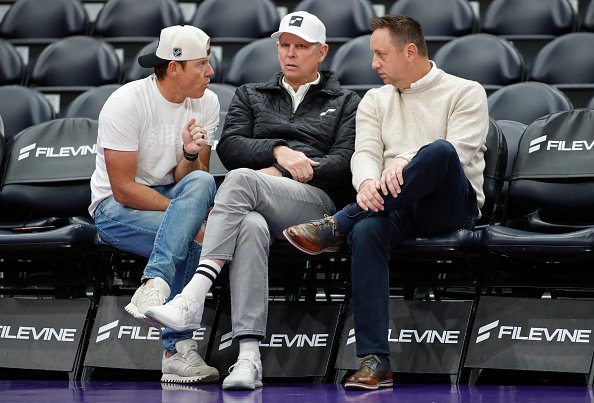
Ryan Smith with Danny Ainge and Austin Ainge at the Delta Center, January 2026. (Photo: Chris Gardner / Getty Images)
The Anchors: Jazz, Soccer, and the Road Back
The Utah Jazz, who built a perennial Western Conference contender around Donovan Mitchell and Rudy Gobert before trading both away beginning in 2022, are now deep in what the front office has been careful to call a "tear-down" rather than a rebuild. The distinction is more than semantic — and Jazz fans have noticed.
What's happening in Salt Lake City resembles what Oklahoma City and Indiana did with patience and draft capital: strip the roster down to its foundation, absorb the losses, and wait for the draft to deliver the talent that makes everything else possible. In the 2025 draft, Utah selected Ace Bailey fifth overall. In 2026, the Jazz are angling for another top pick — the names being circulated include BYU's own AJ Dybantsa, the nation's top-ranked recruit who chose to stay on the Wasatch Front and play college ball in Provo. The alignment between the Jazz's rebuild timeline and Utah's college basketball rising stars is not accidental.
Jazz coach Will Hardy delivered a clear message to his young players heading into this season: "We're not waiting on somebody to come and save us." The front office has been equally direct. President of basketball operations Austin Ainge said the path forward is internal. "A lot of our development has to come internally. The salary cap dictates it, our market dictates it, everything."
“We’re not waiting on somebody to come and save us.”
— Will Hardy, Utah Jazz Head CoachWhat's remarkable — and telling about Utah's sports culture — is that Jazz fans have stayed. Despite four consecutive lottery seasons, the Delta Center has continued to sell out. As the most recent season ended, the Deseret News noted that fans who had willingly rooted for draft position still showed up and screamed, proud to be part of a fanbase that didn't abandon its team when things got hard. Hardy acknowledged the unusual dynamic directly — he knew what other losing teams' arenas looked like around the league. The Delta Center was different.
Across town in Sandy, Utah soccer has been quietly building momentum of its own. Real Salt Lake enters 2026 playing some of its best early-season soccer in years — posting 10 points in its first five games of the MLS season, a mark only matched once in the club's 22-year history. Star midfielder Diego Luna, a homegrown RSL product, was named the MLS Audi Goals Drive Progress Impact Award winner in 2025 and earned a U.S. Men's National Team call-up. With America First Field regularly selling out its 20,000-plus seats, RSL has become one of the quiet success stories of Utah sports.
The Utah Royals, re-launched in the NWSL in 2024, have had a bumpier road. The team went 6-13-7 in 2025 and has yet to make the playoffs in either of its two seasons back. But the franchise's sporting director, Kelly Cousins, set the standard plainly in comments to the Deseret News late last year: "The goal is to win a championship. There's no hiding from that."
What ties all of this together is an ownership picture that is remarkable for a market Utah's size. Ryan Smith's Smith Entertainment Group owns both the Utah Jazz and the Utah Mammoth — giving one Utah-based ownership group a stake in both the NBA and NHL. Separately, the Larry H. Miller Company completed its purchase of Real Salt Lake and the Utah Royals in April 2025, bringing MLS and NWSL under another prominent Utah ownership family. Two homegrown ownership groups. Five major franchises. One market. Very few cities anywhere in the country can say the same.
The Dream on Deck: Baseball Is Coming
If the hockey experiment proved Utah's appetite for major-league sports, the MLB expansion pursuit is the boldest statement of intent yet.
The Larry H. Miller Company's Big League Utah coalition has been positioning Salt Lake City for a Major League Baseball expansion franchise for years, and the effort has moved from aspiration to serious national conversation. In February 2026, the Miller Company announced plans for the $3.5 billion Power District development on Salt Lake City's west side — a 100-acre mixed-use project between the airport and downtown, anchored by a proposed 30,000-seat stadium with the Jordan River running past the outfield wall. Home run balls landing in the river. Visions of McCovey Cove.
Commissioner Rob Manfred has stated publicly he intends to have an expansion process in place before he retires in early 2029. He wants one team in the East, one in the West. Nashville and Salt Lake City have consistently emerged as the frontrunners. The Athletic's senior MLB writer Stephen Nesbitt called Salt Lake City "the frontrunner in the West" in a 2026 analysis, citing the geographic case plainly: "The closer things are bunched together, the more problematic it becomes. And this does sort of fit one of those geographic gaps." Salt Lake City sits 519 miles from Denver and nearly 700 from Phoenix — an island of population in the Mountain West with no MLB neighbor.
Utah has also done the legislative work. State lawmakers passed a bill diverting up to $900 million from rental car tax revenue to help fund a publicly-owned stadium. The Miller Company has pledged the remainder of the $3.5 billion build-out. If MLB decides to expand before 2029 — and most observers believe the process will begin in earnest once the Tampa Bay Rays' stadium situation resolves — Utah is positioned to break ground before a team is even officially awarded.
"When baseball gets ready to expand," Miller Company CEO Steve Starks told KSL, "they'll look at this site and they'll see there's already momentum, there's already progress."
Utah Gov. Spencer Cox put the pursuit in personal terms when he told ESPN what it meant to him as a baseball fan: "Me, my kids, we've missed out on this piece. And I want that."
A 2026 Deseret News/Hinckley Institute poll found 69 percent of Utah voters support the state landing a major league team.
“Me, my kids, we’ve missed out on this piece. And I want that.”
— Gov. Spencer Cox, on landing a Major League Baseball franchiseIf it happens — and right now it looks more like when than if — Salt Lake City would become one of a handful of American cities to simultaneously host franchises in the NBA, NHL, MLS, NWSL, and MLB. That's a remarkable portfolio for a market still broadly categorized as a secondary city.
The Campus Arms Race
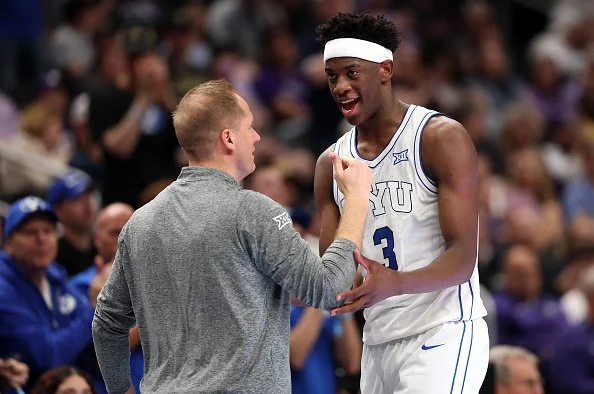
AJ Dybantsa celebrates with Kevin Young as AJ exits a game against Kansas State, March 10, 2026. (Photo by Jamie Squire/Getty Images)
Professional sports expansion alone would be a remarkable story. But along the Wasatch Front, there's a parallel development that quietly amplifies everything — two major college programs, 50 miles apart, now competing against each other in the same Power Four conference.
BYU joined the Big 12 in 2023, becoming one of the conference's early arrivals. Utah followed in 2024 as the Pac-12 collapsed around them — losing USC, UCLA, Oregon, and Washington to the Big Ten in rapid succession before Utah made the move to the Big 12 for the 2024–25 season. What was once a regional rivalry that the University of Utah had tried to walk away from — not long ago, some in the Utes program called the annual Holy War game against the Cougars a "nuisance" — is now a nationally televised showdown between two programs actively competing for Big 12 championships and College Football Playoff berths.
In 2025, both teams entered their October rivalry game ranked — a combination that had happened only three times in the rivalry's history. BYU, under first-year quarterback Bear Bachmeier, finished the regular season 10-1 and reached the Big 12 Championship Game. Utah, under head coach Kyle Whittingham, retooled its offense entirely by bringing in a new coordinator and a transfer quarterback from New Mexico. A columnist for the Salt Lake Tribune, writing about the scheduling debate over the rivalry game, put the transformation in plain terms: the BYU-Utah game, once treated by the Big 12 as just another contest, is the region's most culturally significant athletic event — and deserves to be treated accordingly.
In 2025, both teams entered their October rivalry game ranked — a combination that had happened only three times in the rivalry’s history.
Both programs competing in the Big 12 has changed how Utah is perceived as a college sports market. National recruiting pipelines that once bypassed the Wasatch Front now stop here. National broadcast windows that once went elsewhere now light up Salt Lake City and Provo on Saturday afternoons.
The 2034 Winter Olympics, awarded to Salt Lake City, adds another layer to Utah's athletic legitimacy. A market that will host the world's premier winter sports event in eight years is not a market that sports investors treat as temporary.
The Mid-Major Climb
The BYU-Utah rivalry commands the national spotlight, and it should. But the Wasatch Front's college sports story doesn't begin or end in Provo and Salt Lake City. Across the state, programs at smaller schools have been building national-caliber reputations with less fanfare and far fewer resources — and some of them are about to step into much bigger rooms.
The most striking example sits in Cedar City. The Southern Utah University women's gymnastics program — known to a passionate and growing fan base as the Flippin' Birds — has won three consecutive conference championships: the Mountain Rim title in 2023, followed by back-to-back championships in the Mountain Pacific Sports Federation in 2024 and 2025. In 2025, the program swept every major MPSF end-of-year award, including Coach of the Year for Scott Bauman, who has led the program for 34 years. Sophomore Niya Randolph was named MPSF Gymnast of the Year for the second consecutive season, finishing the regular season as the conference's top all-around gymnast.
The program's record off the mat is equally impressive. SUU Gymnastics holds a perfect 100 percent NCAA Graduation Success Rate, and in 2023-24 posted the second-highest team GPA in the country, with every athlete earning WCGA Scholastic All-American honors.
Beginning in July 2026, the Flippin' Birds will become single-sport members of the Pac-12 Conference — a league that, even after the mass departure of UCLA, Oregon, Utah, and others to the Big Ten and Big 12, still carries one of the most recognized brand names in college athletics. For a program built in Cedar City on hard work and four decades of continuity under one coach, competing on a Pac-12 stage represents a remarkable arc. SUU Interim Athletic Director Tom Higbee said it directly: "Joining the PAC-12 aligns with our goals for national competitiveness and provides our student-athletes the stage they deserve."
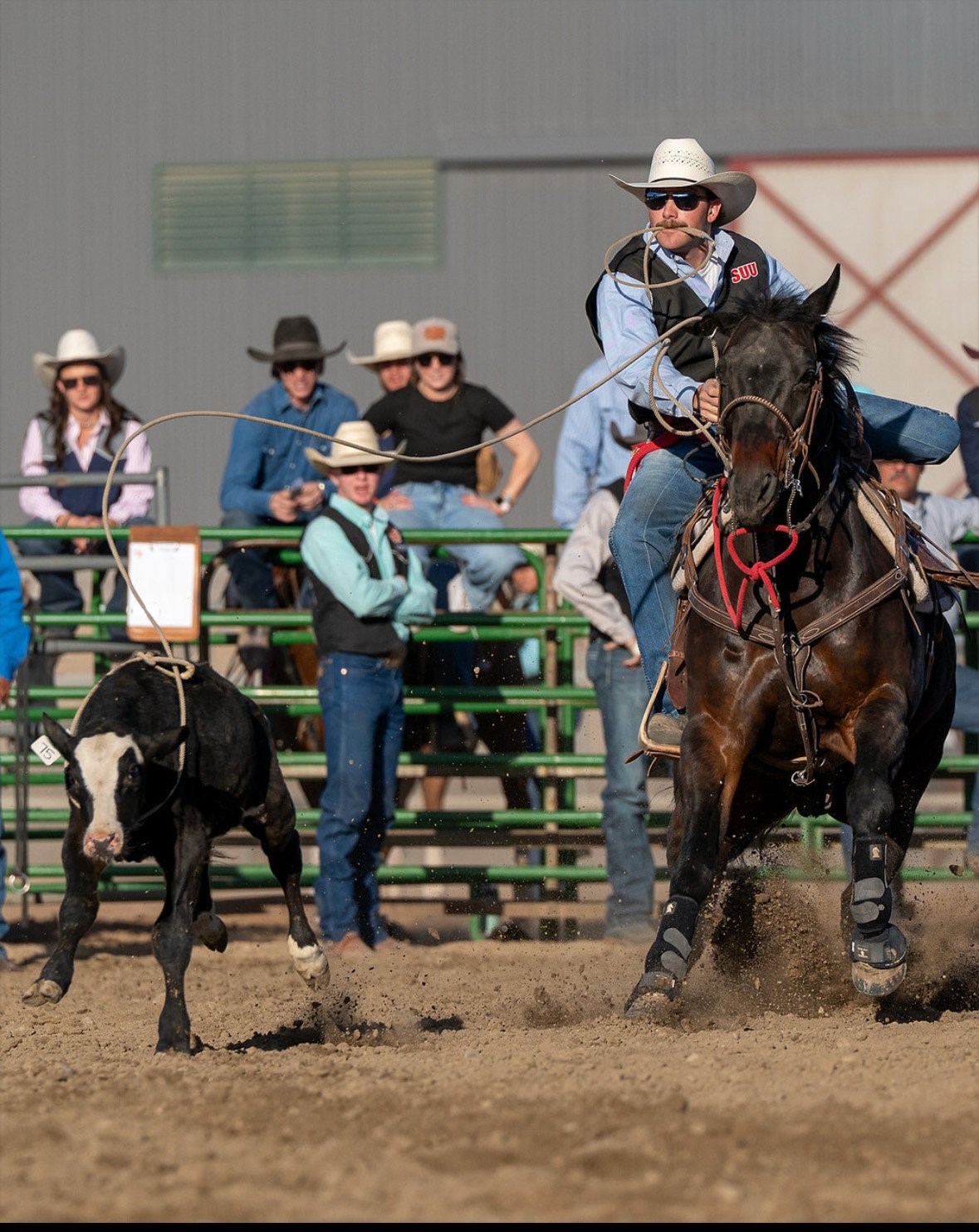
Blake Bowler of SUU ranks 1st Nationally in Team Roping Header
(Photo courtesy of SUU Rodeo Team)
SUU's rodeo program has been making its own statement. The Thunderbirds have been one of the Rocky Mountain Region's most consistent competitors throughout the 2025-26 NIRA season, trading top finishes with Snow College and running strong enough to establish themselves as one of Utah's premier collegiate rodeo programs. It is the kind of sustained performance that rarely makes the front page but earns deep respect in the communities that follow the sport — and those communities are national in scope. College rodeo draws passionate audiences from across the Mountain West and beyond, and Utah's programs have built a reputation in those circles that most sports fans along the Wasatch Front may not fully appreciate.
Utah’s rise as a sports market isn’t happening only at the top. It’s happening at every level simultaneously — and that is what makes this moment genuinely rare.
What unites these stories is something important about how Utah's sports identity is actually built. The ambition runs from the Delta Center all the way to the gymnastics floor in Cedar City and the rodeo arenas across the state. Utah's rise as a sports market isn't happening only at the top. It's happening at every level simultaneously — and that is what makes this moment genuinely rare.
The Question Behind the Curtain
For all the momentum, there is a question that serious sports business observers will eventually press: can the Wasatch Front sustain all of it?
It's not a cynical question. It's an honest one. Utah's population is growing faster than almost any state in the country, and its median household income ranks among the highest of any MLB expansion target. But the fan dollar is finite. The Jazz, Mammoth, RSL, Royals, the college programs, the Salt Lake Bees — that's a lot of seats to fill, a lot of corporate sponsorship to sell, a lot of weeknights and weekends to compete for.
The early evidence is encouraging. The Jazz sell out even while rebuilding. The Mammoth sold out its entire inaugural season before a game was played. RSL is setting early-season records. The Royals, despite their on-field struggles, are reporting strong season ticket sales heading into 2026. The market is broad, and it appears to have real depth.
The harder question isn't attendance — it's the long game. Can BYU and Utah continue to ascend together without cannibalizing each other's recruiting classes, fan dollars, and cultural narrative? Can a Utah NHL team keep pace as the league inevitably demands a larger arena? And if Salt Lake City lands baseball, does the Jazz's rebuild finish in time to keep the NBA anchor solid while a new sport builds its own roots?
These are good problems — the kind that only come when a market has proven itself. Fifteen years ago, Utah had one major professional franchise and two college programs that couldn't agree on whether they belonged in the same conversation. Today, the Wasatch Front is looking at a potential five-sport, two-Power-Four landscape, with a thriving mid-major tier beneath it, anchored by a 2034 Olympics and backed by one of the most invested ownership ecosystems in American sports.
Ryan Smith's group owns the Jazz and the Mammoth. The Larry H. Miller Company owns RSL, the Royals, and the Salt Lake Bees, and is leading the MLB charge. SUU's Flippin' Birds are headed to the Pac-12. The Thunderbirds' rodeo team is competing at the top of the Rocky Mountain Region. And somewhere in Provo, a freshman named AJ Dybantsa is playing college basketball in front of sellout crowds while NBA executives watch from the stands.
The barn is already packed. The question is how many barns Utah can build.
The barn is already packed. The question is how many barns Utah can build.
Sources
NHL / Utah Mammoth
Sports Illustrated, "Utah Hockey Club Gets First Win in Franchise History," October 9, 2024
Deseret News, "New Survey Explores Fan Base for Utah's NHL Team," December 27, 2024
Deseret News, "NHL Sets Attendance Record. What Was the Utah Hockey Club's Role?" April 22, 2025
KUER Public Radio, "As Utah Hockey Club's 1st Season Ends, Fans and Players Are Hungry for More," April 15, 2025
Last Word on Sports, "Season Review of Utah Hockey Club's First Year in NHL," April 27, 2025
Wikipedia, "Utah Mammoth" entry (team history, naming, mascot)
Utah Jazz
NBA.com, "2025-26 Season Preview: Utah Jazz," October 2025
Deseret News, "State of the Utah Jazz's Rebuild: A Timeline for Contention," March 2025
KSL, "For Jazz, Development — Not Wins — Will Define the 2025-26 Season," October 2025
Deseret News, "Fans Send Off 2025-26 Utah Jazz with Hope That the Future Is Bright," April 10, 2026
Real Salt Lake / Utah Royals
RSL.com, club news and match reports, April 2026
Deseret News, "Larry H. Miller Family Buys Real Salt Lake, Utah Royals FC," April 18, 2025
Deseret News, "After a Challenging 2025 Season, What's Next for the Utah Royals in 2026?" November 2025
Deseret News, "Utah's Shifting Sports Landscape: What These Teams Have in Store for Fans in 2026," January 2026
MLB Expansion
ESPN, "Salt Lake City Group Joins MLB Expansion Chase," April 2023
Deseret News, "Salt Lake City Making Splash Amid MLB Expansion Talk," February 28, 2026
Deseret News, "When Will Salt Lake City Get a Major League Baseball Team?" March 25, 2026
KSL, "MLB Could Announce Expansion Plans by 2029. Utah Will Be Ready to Build Before Then," October 2025
KSL Sports, "Why Utah Is Rising as a Top MLB Expansion Candidate," February 2026
Big League Utah, bigleagueutah.com
BYU / Utah / Big 12
Deseret News, "BYU's 2025 Football Schedule Released," February 2025
Vanquish The Foe, "BYU vs. Utah: Is 2025 the Biggest Holy War Ever?" October 2025
Deseret News, "Big 12 Football Power Rankings: Utah, BYU Climb After Big Wins," October 2025
Salt Lake Tribune, "Utah-BYU Football Rivalry Game Should Be Moved Back in Big 12 Schedule," February 2025
Deseret News, "BYU-Utah Rivalry: Have Stakes Ever Been Higher for Both Teams?" October 2025
Sports Illustrated / SI College Utah, "Why the Big 12's Scheduling Decision on Utah-BYU Will Backfire," January 2026
SUU Gymnastics
SUU Athletics, "Southern Utah Gymnastics Set to Join PAC-12 Following the 2026 Season," September 4, 2025
SUU Athletics, "Thunderbirds Take It All: SUU Gymnastics Sweeps MPSF End-of-Year Awards," March 20, 2025
SUU Athletics, "Southern Utah Gymnastics Ranked #31 in 2025 WCGA Preseason Poll," December 2024
Wikipedia, "Southern Utah Thunderbirds Women's Gymnastics" entry
College Rodeo
National Intercollegiate Rodeo Association (NIRA), Rocky Mountain Region 2025-26 Standings, collegerodeo.com
College of Southern Idaho Athletics, Spring 2026 regional rodeo results, March 2026
Casper Star-Tribune, "Final Results from the 2025 College National Finals Rodeo," 2025
Research compiled with AI assistance. All sources independently verified by Mountain & Main editorial staff.