

The Big Screen Isn’t Dead – It’s Just Been Resting
And this spring, it wakes up.
There's something that happens in a movie theater that cannot be replicated anywhere else. The lights go down. The projector hums to life. Two hundred strangers in the dark become, for two hours, a single living organism — laughing together, flinching together, quietly crying in the cover of darkness together. It's one of the oldest communal rituals of American life.
And for the past several years, we've been told it's dying.
They were wrong. Or at least, they were premature.
This spring — right now, in March and April 2026 — the theatrical movie experience is engineering one of the most compelling comebacks in entertainment history. And if you haven't been back to a theater in a while, there has never been a better moment to return.
The Dream Factory: How It All Began
The story of the American movie theater is, at its heart, the story of American community.
It begins at the very end of the 19th century, when Thomas Edison rented a New York vaudeville hall in April 1896 to show a moving picture — an event widely considered America's first theatrical movie experience. Within two decades, ornate "movie palaces" were rising in cities across the country, gilded with chandeliers and velvet curtains, offering ordinary working people a two-hour escape into wonder.
By the 1930s and early 1940s — Hollywood's Golden Age — going to the movies wasn't a special occasion. It was a weekly habit. More than 80 million Americans attended at least one movie per week during the height of that era. Studios like MGM, Paramount, Warner Bros. and 20th Century Fox were producing hundreds of films a year, and the names on the marquees — Cary Grant, Rita Hayworth, Humphrey Bogart, Katharine Hepburn — were the closest thing to royalty that America had.
Films like Casablanca, The Wizard of Oz, Gone With the Wind, and It's a Wonderful Life didn't just entertain — they shaped the American character.
Then came television.
The First Threat: The Little Box in the Living Room
In the late 1940s and 1950s, the television set crept into American homes and changed everything. Why dress up and drive downtown when Milton Berle was already in your living room? Movie palaces shuttered. Studios faltered. The golden studio system, once invincible, cracked under the pressure of a technology that brought entertainment directly to the couch.
Hollywood's response was characteristically American: go bigger. Cinemascope. Technicolor. 3D. Epic productions like Ben-Hur and Lawrence of Arabia offered spectacle that no 12-inch TV screen could match. It worked — enough, anyway. The industry survived.
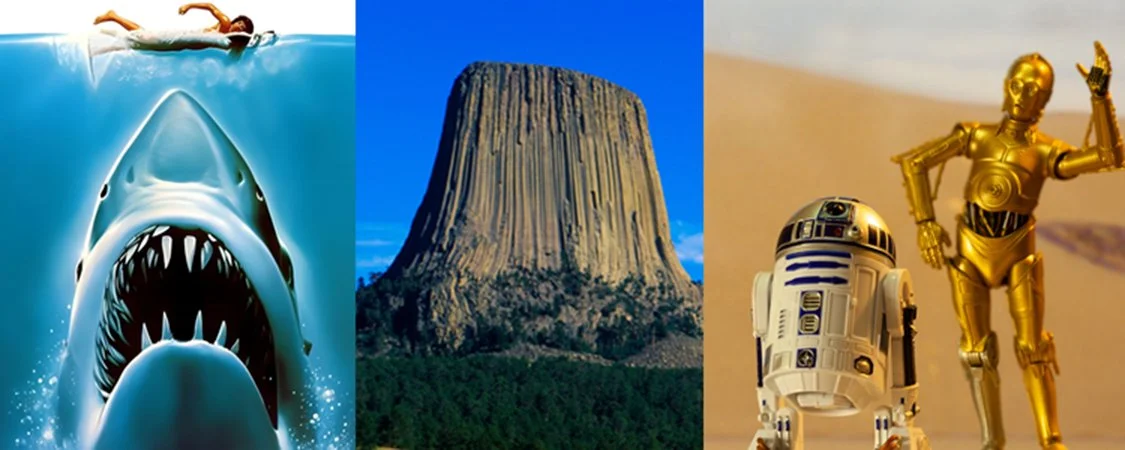
The 70s were the second golden age of sorts for the big screen – Jaws, Close Encounters and Star Wars just weren’t films; they were cultural events. The summer blockbuster was born. (Images from Adobe Stock)
Then came a second golden age of sorts, born in the 1970s. A new generation of directors — Spielberg, Scorsese, Coppola, Lucas — reimagined what movies could be. The Godfather. Jaws. Star Wars. Close Encounters of the Third Kind. These weren't just films; they were cultural events. The modern summer blockbuster was born.
Jaws in 1975 essentially invented the concept. Star Wars in 1977 proved it wasn't a fluke. For the next two decades, summer at the movies was a national ritual. Box office records shattered annually. Theater chains expanded. Multiplexes replaced movie palaces — less elegant, but everywhere.
Drive-In Dreams: America's Other Movie Church
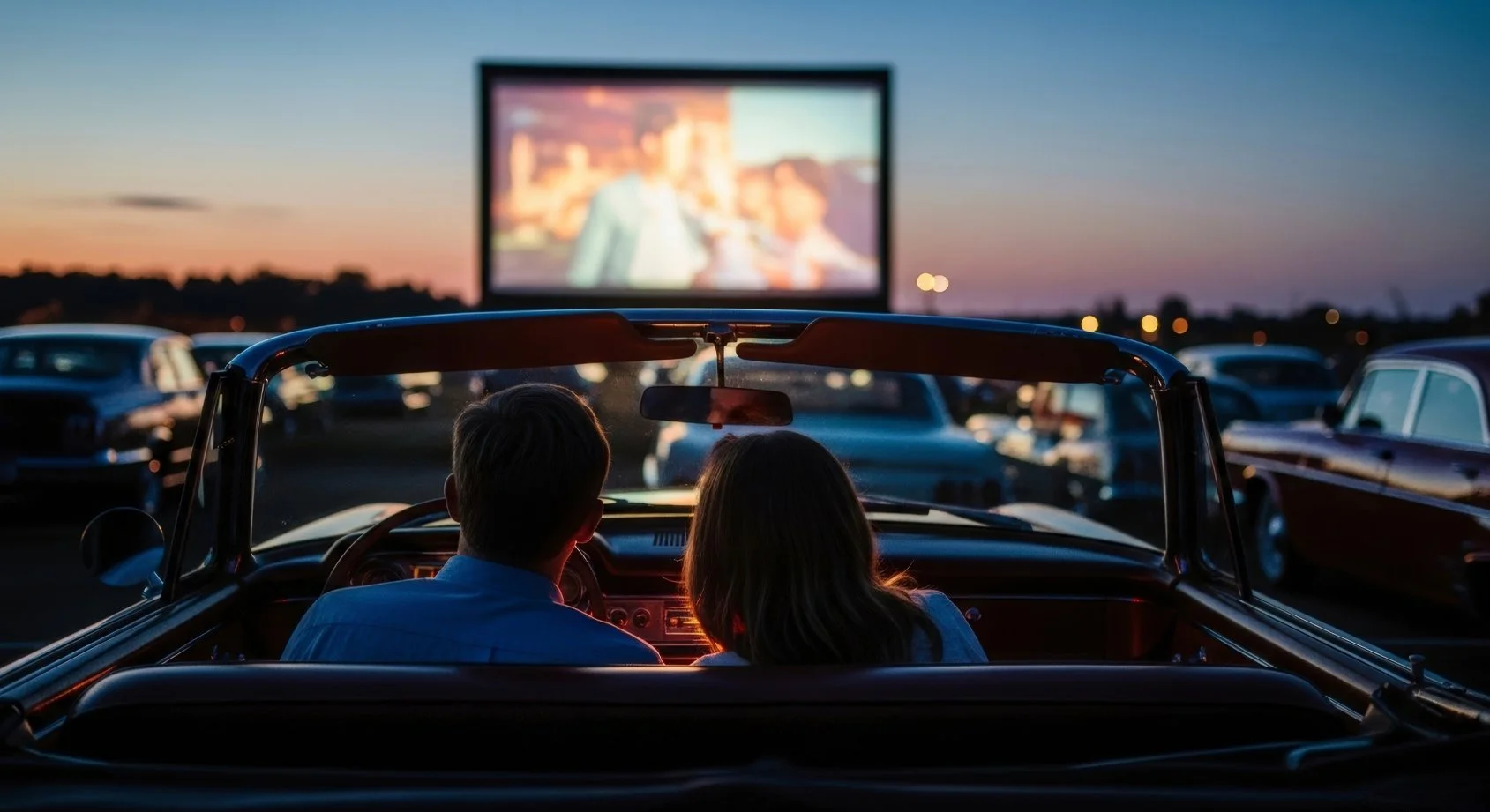
The drive-in faded in the 1970s and 1980s
At its peak, more than 4,000 drive-in theaters operated across America. They weren't just movie venues — they were social institutions. Hot rods gleaming under floodlights. Teenagers on dates. Families in station wagons with kids asleep in the backseat.
No history of the theatrical experience is complete without honoring the drive-in theater — perhaps the most purely American invention in entertainment history.
In 1933, a New Jersey entrepreneur named Richard Hollingshead opened the first drive-in theater in Camden, promoting it as a place where "the whole family is welcome, regardless of how noisy the children are." The concept exploded in the post-war boom of the late 1940s and 1950s. At its peak, more than 4,000 drive-in theaters operated across America. They weren't just movie venues — they were social institutions. Hot rods gleaming under floodlights. Teenagers on dates. Families in station wagons with kids asleep in the backseat.
The drive-in faded in the 1970s and 1980s, squeezed out by rising land values, the oil crisis, and the arrival of home video. From 4,000, the number dwindled to a few hundred survivors.
Interestingly, the pandemic of 2020 gave the drive-in a brief, unexpected revival. With indoor theaters closed by government order, the drive-in — contact-free and nostalgic — suddenly felt like the safest and most romantic option in the country. For a generation that had never experienced one, it was a revelation.
Some things refuse to die because they're too good to die.
The New Threat: The Algorithm on Your Couch
By the late 2010s, a new enemy had emerged — one far more seductive than television ever was.
Netflix launched its streaming service in 2007. By the mid-2010s, it had fundamentally altered what Americans expected from entertainment: anything, anytime, on demand, on your own schedule, for one low monthly price. Amazon Prime Video, Hulu, Disney+, and Apple TV+ followed. Suddenly, studios that had built their business on theatrical windows — the exclusive period when a new film played only in theaters before reaching home video — were under enormous pressure to shrink those windows or abandon them entirely.
Then COVID-19 arrived in March 2020 and did what no streaming platform could have achieved on its own: it closed every movie theater in America overnight.
The numbers are staggering. Ticket sales collapsed from an average of 3.73 annual visits per American in 2019 to just 0.66 visits per person in 2020. More than 5,700 screens closed permanently. Major chains filed for bankruptcy. Studios, desperate for revenue, began releasing films simultaneously in theaters and on streaming platforms — or bypassing theaters entirely.
Audiences got used to it. And habits, once formed, are stubborn.
The Long Crawl Back
When theaters reopened in 2021 and 2022, the recovery was slow and uneven. Some films — Top Gun: Maverick in 2022, Barbie and Oppenheimer in 2023 — proved that audiences would still show up in enormous numbers for the right movie. The "Barbenheimer" phenomenon in the summer of 2023, when moviegoers dressed in pink or in black and attended both films on the same day, reminded the culture that going to the movies could still be a communal event, even a joyful act of rebellion against the screen in your pocket.
By 2023, the domestic box office reached $9 billion — the best post-pandemic performance yet. But it was still 20% below the pre-pandemic high of $11.9 billion in 2018.
2025 was supposed to be the breakthrough year. It wasn't. Plagued by a weak slate, ongoing aftershocks from the 2023 Hollywood writers' and actors' strikes, and the lingering habit of "I'll wait for streaming," the 2025 domestic box office came in around $8.6 billion — flat with 2024 and deeply disappointing to an industry that needed a win.
The honest assessment: theaters have never faced more structural competition. Average ticket prices now run around $13.29 — higher for the premium large-format experiences (IMAX, Dolby, 4DX) that have become increasingly important to the survival of exhibition. Studios are under pressure from streamers who want films released on their platforms as quickly as possible. The theatrical window — once 90 days — has been compressed to as little as 17 days in some cases.
AMC CEO Adam Aron has been vocal: "Shorter windows are the reason [the recovery has taken so long]. You have to conclude that all this experimentation has failed. Hollywood is leaving money on the table."
He's right. And the data backs him up: Disney's Zootopia 2 — which maintained a 100-plus day theatrical window — became the highest-grossing animated opening of all time and crossed $1.46 billion globally. You don't get there by putting a film on a streaming app in 17 days.
Why 2026 Is Different
Here's what the doom-and-gloom narratives tend to miss: the theatrical business has always survived every technological threat it has ever faced. Television. VHS. DVDs. On-demand cable. Streaming. Each time, the industry evolved, adapted, and found reasons to give audiences something the living room couldn't replicate.
The survival instinct is deep. And right now, several forces are converging in theaters' favor.
The slate is genuinely strong. After years of franchise fatigue and content deserts, the 2026 release calendar is stacked with films that have broad, proven audience appeal — from the Super Mario Galaxy Movie to a Michael Jackson biopic to Christopher Nolan's The Odyssey later in the year. These are event films, the kind people want to experience together, not alone on a laptop.
Premium formats are thriving. IMAX, Dolby, and 4DX continue to gain market share post-pandemic, because they offer something absolutely impossible to replicate at home. The premium large-format ticket has become the theater's best argument for its own existence — and audiences are buying it.
The "event movie" culture is being rebuilt. The Barbenheimer phenomenon unlocked something important: going to the movies can be fun again, with costumes and themed popcorn buckets and the electricity of an audience that genuinely wants to be there. Fans who showed up in Hogwarts robes for Harry Potter anniversary screenings, and dressed as their favorite Minecraft characters for this year's A Minecraft Movie are rewriting the social contract around moviegoing.
Classic films keep proving their power. Re-releases of beloved films — Jaws, Star Wars, and others on anniversary tours — have demonstrated that audiences will pay to see older movies on a big screen, especially movies they've only ever watched at home. The theater isn't just a delivery mechanism for new content; it's a living museum of cinematic culture.
Industry alignment is shifting. Studios and exhibitors are increasingly aware that a shorter window isn't just bad for theaters — it's bad for the films themselves. The theatrical run is the cultural moment when a film enters the conversation. Shrink that window and you shrink the film's cultural footprint.
The Philosopher's Case for the Big Screen
There's something worth saying here that the box office analysts don't often address: movies in theaters are not the same thing as movies on your phone.
They never were.
Netflix's own co-CEO, Ted Sarandos, told CBS News that his earliest moviegoing memory — watching Jaws as an 11-year-old in a theater — shaped him indelibly. "Popcorn went this way, and the soda went this way, and the audience screamed," he said. "And that's a very unique and different experience." This from the man running the company most responsible for pulling audiences away from theaters.
Director and filmmaker Tom Rothman put it plainly: "You can have quality or you can have quantity; it is extremely difficult, if not impossible, to have both quality and quantity together. What does streaming have? It has quantity. And it's a very low bar."
The great romantic comedy director Nancy Meyers, whose films have earned over $1.5 billion, reflected on what has been lost: "Hollywood used to be called a dream factory. Somebody's dream is up on the screen — somebody's version of a world that you get pulled into. The lights come up at the end and you've been somewhere. You've had an experience when you're in a movie theater. That's what a movie is."
She's describing something real. In a theater, you can't pause. You can't look at your phone (well — you shouldn't). The darkness is collective. The experience is shared. And in a world that increasingly delivers entertainment algorithmically, on a device, in isolation, there is something almost radical about sitting in the dark with strangers and agreeing to be moved by the same story at the same moment.
That's not nostalgia. That's community. And it still matters.
This Spring: Go Back to the Movies
If there was ever a time to re-establish the moviegoing habit, it's right now.
March and April 2026 offer one of the more compelling theatrical slates in years. Pixar's Hoppers is the studio's bid to reclaim its identity with a high-concept original story. Project Hail Mary, adapted from Andy Weir's beloved novel with Ryan Gosling in the lead, promises the kind of intimate, intelligent sci-fi that plays best when you're fully immersed. The Super Mario Galaxy Movie returns the franchise's enormous cast for what shapes up to be a true family event. Antoine Fuqua's Michael — the Michael Jackson biopic starring Jaafar Jackson as his legendary uncle — is one of the year's most anticipated prestige releases.
These are films built for the big screen. Built for the shared experience. Built for the moment when the lights go down and two hundred strangers agree, just for tonight, to go somewhere else together.
The dream factory is still running. The screen is still lit.
All you have to do is show up.
For showtimes and ticket links for all current theatrical releases in the Salt Lake/Wasatch Front area, visit our New Movies listings in The Main Event.