

Getting to The Point
On 600 acres of state-owned land in Draper, Utah’s most ambitious development project is building something America has never seen; a 15-minute city from scratch
Where Utah’s old state prison once stood, excavators are now carving out the foundation of what could become the most closely watched community development in the country. It’s called The Point, and its ambition is as straightforward as it is audacious: build a place where everything a person needs–work, school, shopping, dining, entertainment, and open space–sits within a fifteen-minute walk from home.
The idea isn’t new to the rest of the world. The 15-minute city concept was coined by Franco-Colombian urbanist Carlos Moreno and gained international traction when Paris Mayor Anne Hidalgo made it the centerpiece of her 2020 reelection platform, converting car lanes to bike paths and transforming schoolyards into neighborhood parks. Barcelona followed with its “superblocks” program restricting car traffic. Melbourne adopted “20-minute neighborhoods” as part of its long-range city plan. Shanghai launched “15-minute community life circles” reaching across 50 Chinese cities. But those efforts have all been retrofits–reshaping existing urban fabric. The Point is the first community in the United States designed and built around the 15-minute model from the ground up.
Governor Spencer Cox and state legislative leaders broke ground on Phase One in December 2024, launching construction of Porter Rockwell Boulevard, the spine of a 100-acre initial buildout that will include over 3,000 residential units, a retail promenade along a restored stretch of the Jordan River, and a 5,000-seat entertainment venue designed by global architecture firm Gensler. The private-sector development partner, Innovation Point Partners–a consortium of Lincoln Property Company, Colmena Group, and Draper’s own Wadsworth Development Group–has committed more than $2.3 billion in financing. The Utah Legislature has backed the project with $165 million in infrastructure investment, a loan to be repaid through future ground lease revenue.
The vision extends well beyond bricks and boulevards. A “River to Range” corridor will connect the Jordan River Parkway to the Wasatch foothills and Corner Canyon’s trail network, threading 140 acres of car-free green space throughout the community. Planners are designing what they call a “one-car community,” where households can meet nearly every daily need without getting behind the wheel–supported by dedicated bus rapid transit lanes, a new FrontRunner station, and mobility hubs offering car-share and bike-share access.
The concept is the product of a multi-year public engagement process led by Envision Utah, in which more than 17,000 Utahns contributed feedback through surveys, public meetings, and stakeholder sessions. Executive Director Mike Ambre, who previously oversaw construction of the new state prison facility, expects the first occupied buildings by early 2027, with Phase One continuing to take shape over the next fifteen years. The full 600-acre buildout, envisioned to support roughly 7,400 homes and up to 40,000 jobs, will unfold over a generation.
Brandon Fugal, chairman of Colliers International Intermountain and the firm overseeing office leasing at The Point, believes the model won’t stay contained to Draper. “Established Utah communities can take on 15-minute city conversion,” Fugal has said, pointing to mixed-use development as the blueprint for living, working, and playing within proximity–a philosophy that could reshape neighborhoods up and down the Wasatch Front.
Under the Tracks: A U.S. First in Tunnel Engineering
The stretch of 14600 South near the railroad crossing at 1000 West has long been one of Draper’s most stubborn bottlenecks–a narrow choke point where commuter traffic, freight trains, and a fast-growing population collide. That is about to change. (Story continues below…)
Draper is home to two American firsts:
The country's first 15-minute city built from scratch, and a pioneering road construction technique called box jacking — in which a 4-lane roadway will be installed beneath active railroad tracks without interrupting train traffic.
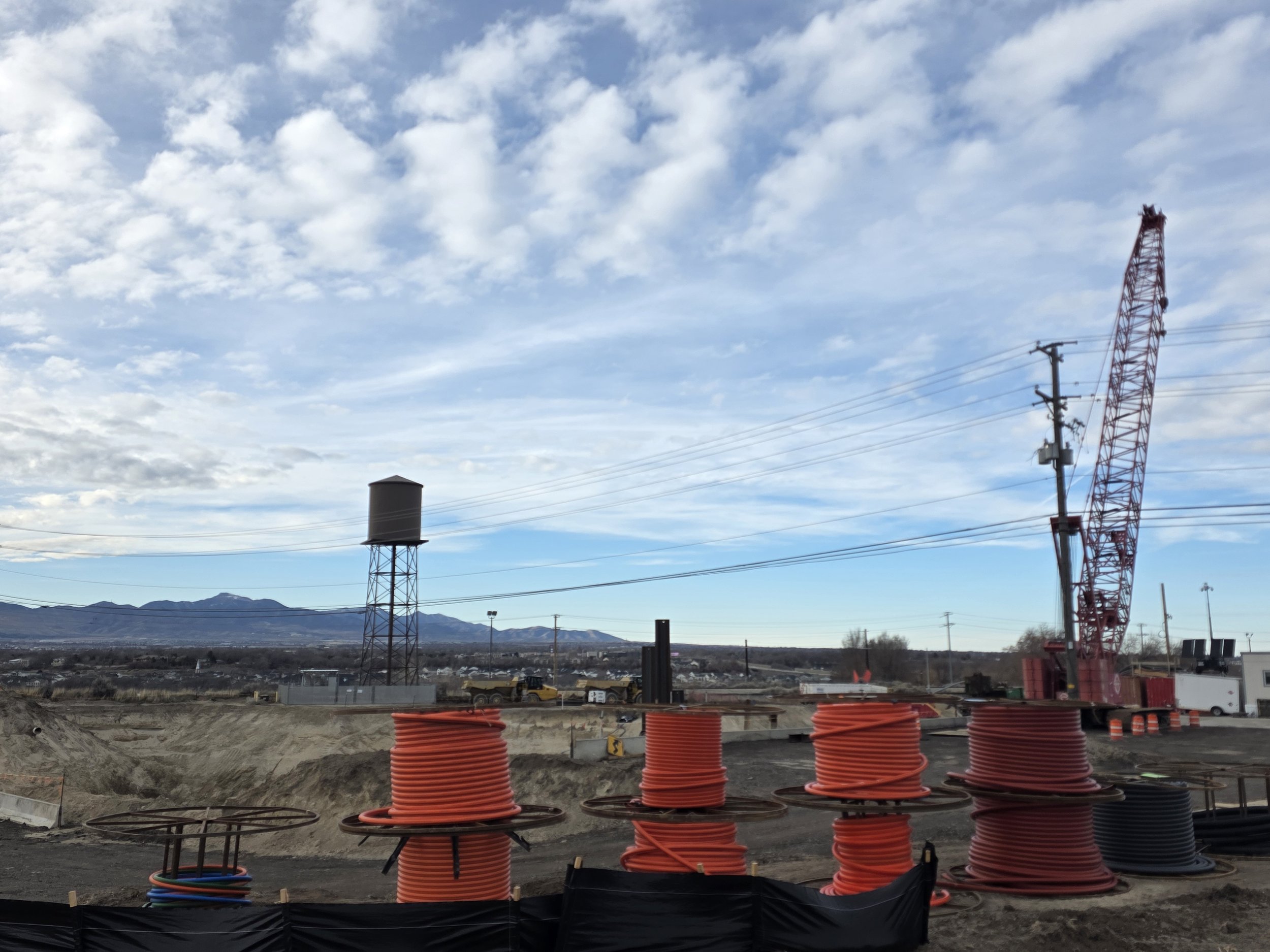
Construction is now underway on a new underpass that will carry four lanes of traffic beneath the tracks, and the method being used has never been attempted on a project of this type in the United States. The technique is called box jacking–a trenchless, hydraulic process that pushes a massive prefabricated concrete box incrementally through the earth beneath the railroad. Because the structure is advanced horizontally rather than built in an open trench, rail operations above continue uninterrupted. It is a method widely used in Europe and Asia but, until now, never deployed for this type of roadway underpass on American soil. When completed, the widened roadway will accommodate two eastbound and two westbound lanes along with 10-foot pedestrian and bicycle paths on each side, engineered to handle projected volumes exceeding 50,000 vehicles per day. Construction is expected to span roughly 15 months from its late-2025 start. Transportation officials are urging commuters to use Porter Rockwell Boulevard or Redwood Road to Bangerter Highway as alternate routes during the work. For The Point, the underpass is more than a road improvement–it is a signal that the infrastructure demands of the Wasatch Front’s most ambitious development are being met with engineering ambition to match.