The Rise of 'Brotox': Why More Wasatch Front Men Are Trying Botox
By the Well & Whole Editorial Team
For decades, the assumption was simple: cosmetic injectables were something women did. That assumption is quietly coming apart — and nowhere is the shift more visible than along the Wasatch Front, where aesthetic clinics from Salt Lake City down to Provo report a steady climb in male clients booking a treatment the industry has nicknamed "Brotox."
It is exactly what it sounds like: Botox, approached and administered with a man's face in mind. Men who a decade ago might have dismissed the idea outright are now scheduling regular, preventative appointments. The numbers track the anecdote. Women still account for the overwhelming majority of botulinum toxin procedures — roughly 94 percent, according to the American Society of Plastic Surgeons — but the male share has been climbing year over year, and the broader market for men's cosmetic treatments has grown sharply over the past two decades. For a lot of these men, the motivation reads less like vanity and more like maintenance: looking less tired, holding a professional edge, and treating skin as one more thing worth keeping up — like the truck, the knees, or the retirement account.
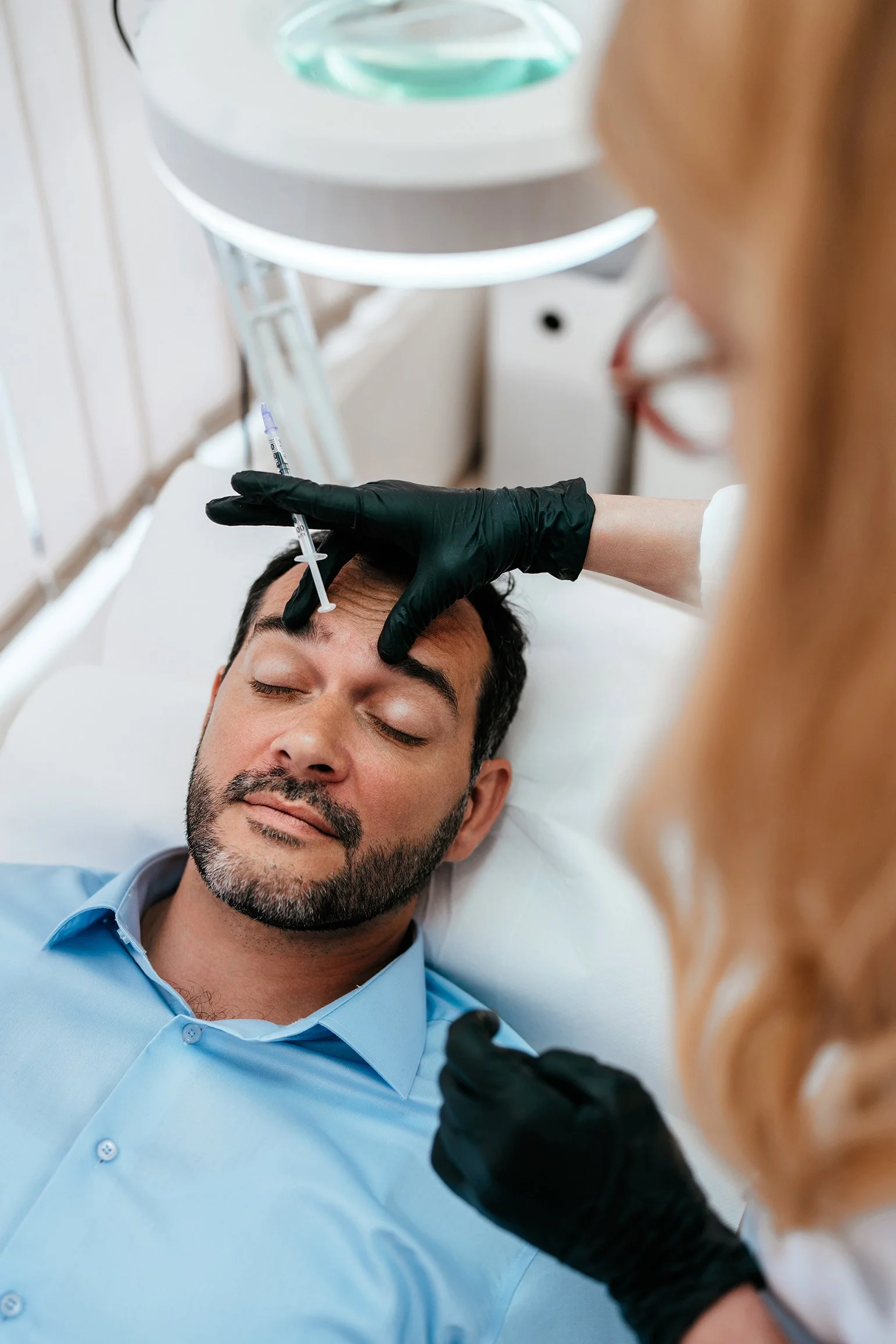
‘Brotox’ For Men
"'Brotox' has become especially popular because it's subtle, preventative, and helps soften signs of stress and aging while still maintaining a natural, masculine appearance."
– Aysia Toronto, an aesthetic nurse injector at Haus of Aesthetics in Salt Lake City
THE ALTITUDE, THE ELEMENTS, AND THE DESK JOB
To understand why the trend has landed so firmly in Utah, start with where Utahns live. Much of the Wasatch Front sits above 4,200 feet, and the thinner air at elevation filters out less ultraviolet radiation than air at sea level. UV exposure rises roughly 4 to 5 percent for every 1,000 feet of elevation — which means a face here absorbs measurably more of it than the same face would on the coast.
That matters because UV is the single largest driver of visible facial aging. Dermatologists estimate that up to 80 percent of how a face ages is attributable to cumulative sun exposure rather than the passage of time itself. Add Utah's dry desert air, hard winter wind, and a population that spends its weekends outdoors — fly fishing the Provo, coaching kids' soccer in the sun, skiing Little Cottonwood — and you have a recipe for accelerated breakdown of collagen and elastin. The visible result is usually the same in men: deep "11s" between the eyebrows and crow's feet fanning out from the corners of the eyes.
Then layer on the desk-job version of the same problem. Long hours and high-stakes work in the Silicon Slopes corridor encourage a more or less permanent furrow. Held often enough, a stress expression becomes an etched-in line, and a man can end up looking tired, stern, or annoyed regardless of how he actually feels.
WHY A MAN'S FACE IS TREATED DIFFERENTLY
The anatomy is genuinely different. Men generally have thicker skin, greater facial muscle mass, and a distinct underlying bone structure — a stronger, lower brow line and a more squared, pronounced jaw. Those differences change how a treatment is planned and dosed. The same number of units placed the same way on a woman's face will not produce the same result on a man's, which is why injectors who work on men describe it as a specialized skill rather than a scaled-down version of the standard procedure.
The goal is different, too. Few male patients want a frozen, polished, expressionless look. The aim is to soften the heaviest furrows while leaving intact the character lines that make a face look lived-in.
"More men are embracing aesthetic treatments because they want to look refreshed and confident, not dramatically different," says Aysia Toronto, an aesthetic nurse injector at Haus of Aesthetics in Salt Lake City. "'Brotox' has become especially popular because it's subtle, preventative, and helps soften signs of stress and aging while still maintaining a natural, masculine appearance."
THE STIGMA IS FADING FASTER THAN THE LINES
Men's grooming used to mean a haircut, a shave, and maybe a splash of aftershave. That definition has expanded. The same man who wouldn't skip an oil change or play through a bad shoulder is increasingly applying that logic to his skin — and, notably, talking about it. Recommendations for SPF moisturizers, hydration serums and, yes, injectors now get traded in gym locker rooms and on golf courses the way truck and tool advice always has. The industry data tracks the cultural shift: the number of cosmetic procedures performed on men in the U.S. has risen dramatically since 2000, with minimally invasive treatments — Botox chief among them — leading the way.
THE TWENTY-MINUTE APPOINTMENT
Part of the appeal is purely logistical. A typical Botox appointment runs under twenty minutes with effectively no downtime — close enough to a true lunch-break procedure that the "lunchtime lift" nickname has stuck. And the results are not instant, which is part of why the change tends to read as natural rather than sudden: most people see initial softening within a few days, with the full effect settling in around two weeks. By the time anyone notices, the question is usually whether you've been sleeping more or changed your diet — not what you had done.
ONE PIECE OF A BIGGER PICTURE
Whatever you make of the trend, it fits a pattern the Well & Whole desk has tracked across the valley: wellness has stopped being one thing. It now spans how people eat, how they train, how they manage their heads through inversion season, and how they present themselves to the world. Injectables are one tool among many, and they are plainly not for everyone. But the men trying them tend to describe the same thing the data suggests — a low-drama, repeatable way to look about as rested as they'd like to feel.