

The Humble Banana: Trail-Ready Fuel That Beats the Granola Bar
Why this 20-cent fruit quietly outperforms most "wholesome" snack bars on the trail, in the gym bag, and on your way out the door.
You probably have one on the counter right now. Maybe a whole bunch — some still green, one perfectly yellow, one going brown faster than you can use it. The banana is quietly the most reliable food in any Wasatch Front household: cheap, pre-wrapped by nature, pocket-sized, and ready to grab on the way out the door. Because it's everywhere, we tend to forget how good it actually is for us.
Here's what's inside one medium banana, anchored to USDA values:
Calories: about 105
Carbohydrate: 27 grams
Fiber: 3 grams Potassium: 422 mg
Vitamin B6: roughly 25% of the daily value
Vitamin C: a modest dose
Magnesium and manganese: small but useful amounts
Fat: essentially zero
Sodium: essentially zero
Protein: 1 gram
That's the kind of nutrient density that doesn't show up on the front of a snack box but still does real work. Potassium alone is reason to pay attention — most American adults fall short of their daily target, and the FDA flags it as a nutrient of public health concern. It supports normal heart rhythm, muscle contraction, and fluid balance, which matters whether you're climbing Ensign Peak or just pushing through a long Tuesday.
How a Banana Gets to Utah
The banana on your counter likely started its journey in Guatemala, Ecuador, Costa Rica, Colombia, or Honduras. Those five Latin American countries supply the overwhelming majority of America's bananas — historically about 94% of U.S. banana imports, with Guatemala alone accounting for roughly a third by value, according to USDA trade data. The U.S. imported about 5 million metric tons of bananas in 2023, worth more than $2 billion. Per capita, Americans eat about 27 pounds of fresh bananas a year — more than any other fruit.
Here's the part most people don't know: every banana you've ever bought was picked green. Harvested ripe, they'd never survive the trip. Workers cut full bunches off the plant while the fruit is still hard and starchy, then rush them to packing facilities to be washed, sorted, and boxed within hours.
From there, the bananas board refrigerated cargo ships and travel at about 56°F — cool enough to suspend ripening, not so cold that the fruit gets damaged. The voyage to a U.S. port takes roughly two to three weeks. Most bananas enter through East Coast and Gulf hubs like Philadelphia, Wilmington, and Gulfport, or West Coast ports like Hueneme and San Diego. From the docks, they ride trucks and rail to regional distribution centers — including the warehouses that supply the Wasatch Front.
The last stop before your grocery store is the ripening room. Bananas are climacteric fruit, meaning they ripen in response to ethylene — a natural plant hormone they actually produce themselves. Distributors load the still-green fruit into airtight, climate-controlled rooms, raise the temperature to roughly 60–70°F, set humidity at 70 to 90%, and pulse in a controlled dose of ethylene gas. Within four to eight days, the fruit turns yellow on a predictable timeline, and out it goes to the produce aisle.
That whole chain — tropical farm, packing house, refrigerated ship, port, distribution center, ripening room, store — runs continuously, year-round, to keep a steady supply at the price you've come to expect. Twenty cents. No wonder it's been America's favorite fruit for decades.
The Pre-Workout and Pre-Hike Case
Bananas hit a sweet spot for active people: fast-acting carbs that don't sit heavy. The mix of natural sugars and resistant starch gives you readily available fuel without the gut churn that hits some folks from a heavier breakfast right before exercise. Coaches and trainers have leaned on this for decades for a reason. Pair one with a tablespoon of peanut butter and you've built protein, fat, and carbs into a 90-second package.
For trail use, the case gets even stronger. Bananas are self-contained — no wrapper to pack out, since the peel composts. They're soft enough to eat one-handed on a switchback. They don't melt in a hot pack like a chocolate-coated bar. And at the top of a Wasatch summit, that quick potassium and sugar lands exactly when you need it.
Banana vs. Granola Bar: A Quick Reality Check
This is where bananas quietly win. Granola and breakfast bars market themselves as the trail snack — the wrapper says "wholesome," the front of the box shows mountains. But the nutrition label often tells a different story. Consumer Reports reviewed a dozen popular granola and oat bars and found just a few that came in under their suggested ceiling of 5 grams of added sugar per serving. A whole Bobo's Original Oat Bar runs 18 grams of added sugar and 340 calories. Nature Valley Oats 'n Honey Crunchy Bars come in at more than double the 5-gram threshold. Calories across the bars Consumer Reports reviewed ranged from 130 to 210 per serving — and for some, "a serving" was just half the bar.
Compare that to a banana: 105 calories, zero added sugar, three grams of fiber, and a real nutrient profile. About 20 cents at the grocery store. No wrapper.
That's not to say every bar is junk — there are honest ones with short ingredient lists and minimal added sugar, and they have their place. But the default trail snack, the one stashed in the side pocket of the daypack, doesn't have to come from a box. It's been on your counter the whole time.
About That Ripeness Question
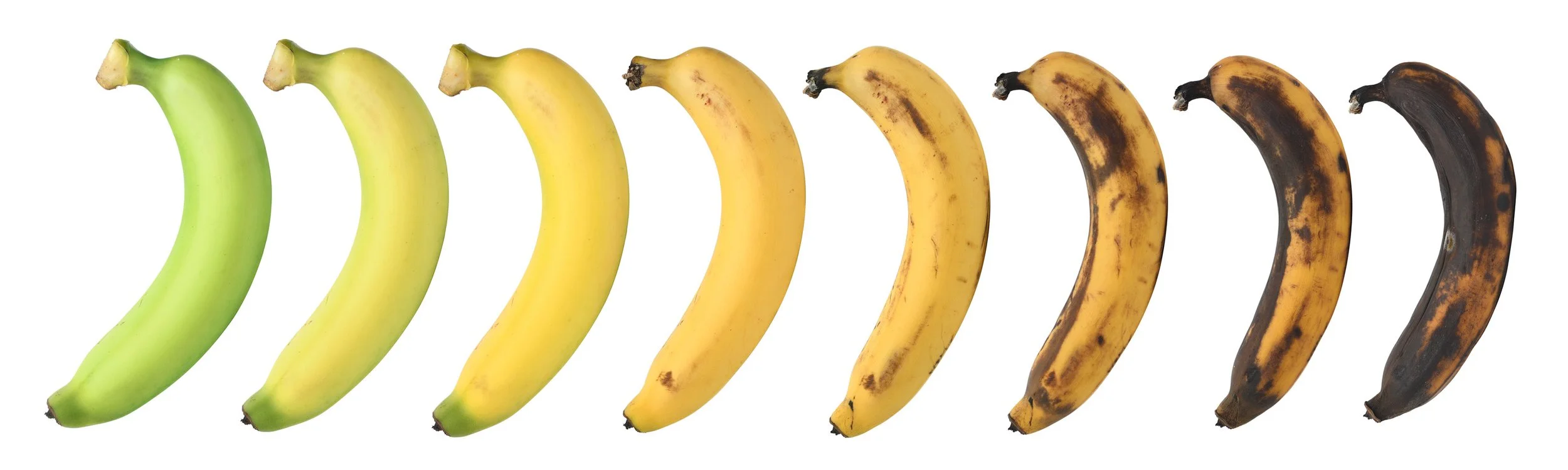
A speckled brown banana isn't a worse banana. It's a different one. As bananas ripen, the resistant starch inside breaks down into simple sugars. The fruit gets sweeter, softer, and easier to digest. The trade-off: the glycemic index climbs. The Harvard T.H. Chan School of Public Health, citing the International Glycemic Index Database, pegs ripe bananas at a GI of 51 (slightly under-ripe at 42) — both still in the low range. Heavily spotted bananas can climb higher, into the 60s.
For most people, that swing doesn't matter much. For anyone managing blood sugar — diabetes, prediabetes, insulin resistance — the less-ripe end of the spectrum is gentler. The flip side: very ripe bananas develop more antioxidants. So eat them at whatever ripeness you enjoy, and use the brown ones for baking or smoothies before they cross the line.
And Banana Bread?
The minerals — potassium, magnesium, fiber — mostly survive the oven. Heat-sensitive nutrients like vitamin C and some B6 take a hit. The bigger issue is what gets added: a typical slice runs 200 to 300 calories with significant added sugar, butter or oil, and refined flour. You're getting some of the banana benefit, diluted by the rest of the loaf. A whole-wheat, low-sugar version keeps more of the nutritional point intact. But let's be honest — if you're baking banana bread, you're not really doing it for the nutrition.
The Bottom Line
The banana is the original convenience food. It's been quietly outperforming the snack aisle since long before "wellness" was a marketing category. Throw two in the daypack before the trailhead. Drop one in the kid's lunchbox. Blend one into the morning smoothie. You're already doing it. Now you know why it works.
Sources
U.S. Department of Agriculture, FoodData Central — "Bananas, Raw" nutrient profile. fdc.nal.usda.gov
U.S. Department of Agriculture, Foreign Agricultural Service / Economic Research Service — U.S. banana import volumes, values, and country-of-origin trade data (2023). usda.gov
University of Florida IFAS Extension, "Banana Market" (publication FE901) — historical and current supplier shares, brand and supply-chain context. edis.ifas.ufl.edu
Harvard T.H. Chan School of Public Health, The Nutrition Source — "Bananas," including glycemic index data from the International Glycemic Index Database. nutritionsource.hsph.harvard.edu
National Institutes of Health, Office of Dietary Supplements — "Potassium: Fact Sheet for Consumers" and "Vitamin B6: Fact Sheet for Consumers." ods.od.nih.gov
U.S. Food and Drug Administration — Daily Value reference and identification of potassium as a nutrient of public health concern. fda.gov
Consumer Reports — "Great-Tasting Granolas Without All the Fat, Sugar, and Calories," March 2025 review of 22 granolas and 12 granola/oat bars. consumerreports.org
Industry-standard banana ripening practice — climacteric fruit response to ethylene, controlled-atmosphere shipping at approximately 13°C / 56°F, and ripening-room conditions (60–70°F, 70–90% humidity, controlled ethylene exposure) drawn from established postharvest produce literature.
This article was developed with AI assistance and fact-checked against the sources listed above.