

What Lives in the Great Salt Lake?And What Happens When the Salt Gets Too High?
There are no fish in the Great Salt Lake. No bass, no trout, no carp. Nothing you could catch.
What lives there instead is a food web with almost nothing in it — a handful of species of algae, a fly, and a half-inch crustacean called the brine shrimp. That is nearly the whole list. And on the strength of that very short list, the lake feeds ten million migratory birds a year and supplies roughly 45 percent of the world’s brine shrimp eggs to fish farms on four continents.
In a recent article we explained where the lake’s water comes from. This issue: what the water is for, and why one number — the percentage of salt in it — decides whether any of it works.
Salt Is the Lever
The Great Salt Lake has no outlet. Water arrives and leaves only by evaporation, and the salt it carries stays behind. That means the lake’s salinity is not a fixed property. It is arithmetic. Less water, same salt, higher concentration.
This is why lake elevation matters beyond the shoreline. Every foot the lake drops, the remaining water gets saltier. And brine shrimp — as tough as they are — have a ceiling.
State managers target a spring salinity of 9 to 12 percent in the south arm, the shallower, more productive half of the lake where the ecosystem actually lives. Ocean water, for comparison, is about 3.5 percent. At the 2022 record low, south arm salinity spiked to roughly 18 to 19 percent. As of mid-August it sits near 13 percent.
That gap — from the top of the healthy range at 12 percent to the collapse zone above 18 — is the difference between a functioning lake and a collapsing one.
What 2022 Taught Utah
The collapse was not theoretical. It happened, and the numbers are on the record.
Brine shrimp lay dormant eggs, called cysts, that overwinter and hatch in spring. In a healthy year, more than 90 percent of them hatch — a rate so reliable it is the reason Great Salt Lake cysts are considered the best in the world. In the high-salinity year that followed the 2022 low, the hatch rate fell to about 60 percent.
The commercial harvest tells the same story. A normal decade-average season runs 25 to 35 million raw pounds of cysts. The 2022–23 season produced roughly 19 million.
Biologists also documented brine flies — the other half of the birds’ diet — vanishing from stretches of shoreline.
The Fix Was a Pile of Rocks
A railroad causeway — a rock-and-fill roadbed built straight across the open water — has split the lake in two since the late 1950s. Almost all of the lake’s incoming water arrives on the south side. The Bear, the Weber, and the Jordan all empty into the south arm; the north arm gets very little. For sixty-some years it has been evaporating with almost nothing coming in, and it is now so salty that brine shrimp cannot live there at all.
In 2016, a breach was cut through the causeway to let the two halves exchange water. But salt water is heavier than fresh, so the exchange does not work like stirring cream into coffee. The north arm’s brine sinks and slides south along the bottom as a dense layer underneath. In an ordinary year that is manageable. In 2022, with the south arm already at a record low and its own salt concentration climbing, it was not.
That summer the state raised a berm in the breach — essentially pushing rock into the gap with heavy equipment — to shut off the flow, then raised it again the following February, to 4,192 feet, under a governor’s executive order. The berm does not hold back water. It holds back salt, and specifically it stops a one-way transfer from the dead half of the lake into the living half.
It worked, with help. The winter that followed produced a record snowpack, and the runoff diluted what the berm had already walled off. The 2023–24 harvest rebounded to roughly 29 million pounds and hatch rates returned above 90 percent. The 2025–26 season, which ran on an emergency extension into February, totaled more than 40 million raw pounds.
It is worth being precise about what the berm buys. It does not add a drop of water to the lake. It redistributes the salt already in it. That is a holding action, not a recovery.
State officials have said the berm will be closed entirely if the south arm drops to 4,190 feet, trapping next spring’s runoff in the south arm, and that mineral extraction companies would be barred from taking new water until the lake rises back above that line.
In September, the Birds Arrive
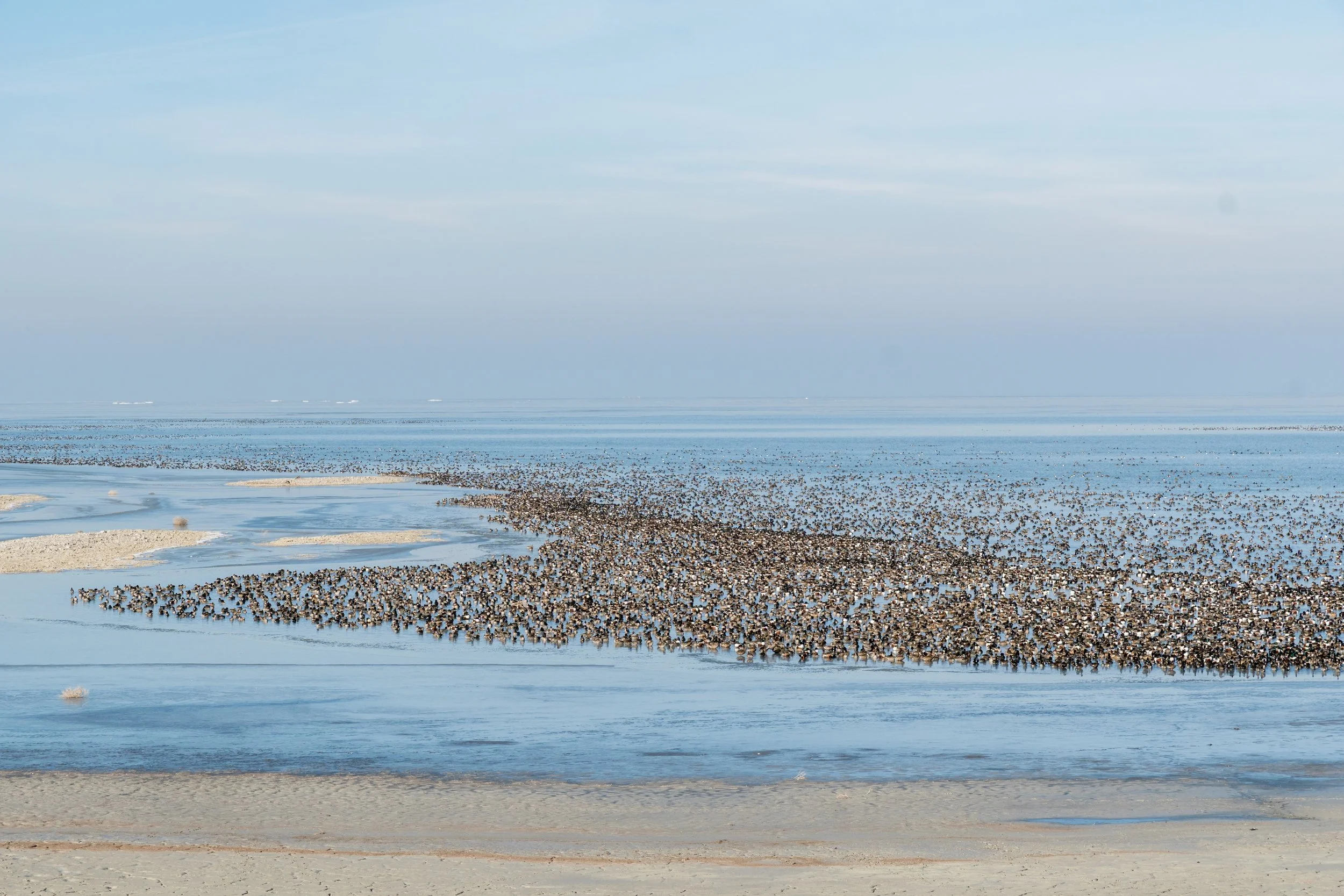
This is the part that makes fall the right month to explain any of it.
Beginning in late summer, eared grebes — small dark waterbirds with red eyes — converge on the Great Salt Lake from breeding grounds across western North America. Estimates run from 3 to 5 million birds, representing the large majority of the continental population. Nearly every eared grebe in North America stages at either this lake or Mono Lake in California.
Here is what makes them so exposed: while they are here, they molt. Their flight feathers drop out, their chest muscles atrophy, and their digestive organs enlarge. For weeks, they cannot fly. They are stuck on this lake, and they eat brine shrimp — 25,000 to 30,000 per bird, per day — until they have roughly doubled their weight and rebuilt the muscles to leave.
A bird that cannot fly cannot go find a better lake.
Wilson’s phalaropes come through earlier, in mid to late summer, in numbers exceeding half a million — better than a third of the world population — and also double their body weight before flying to South America. All told, some 330 species and around ten million birds pass through the lake and its wetlands each year.
They are not here for the scenery. They are here because of what the salt content allows to grow.
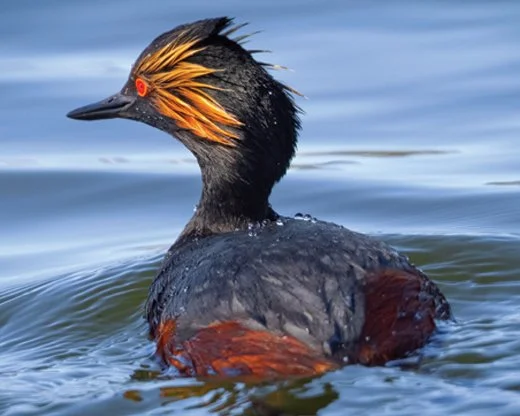
Go See The Birds This Fall at Great Salt Lake
The grebes gather in huge floating flocks, visible from shore in late September and October. Four places to look:
Antelope Island State Park causeway — 4528 W 1700 S, Syracuse. Pull-offs along the seven-mile causeway put you at eye level with open water. Day-use fee. stateparks.utah.gov
Farmington Bay Waterfowl Management Area – 1325 W Glover Ln, Farmington. Free. The auto tour route is the easiest birding in the state and the George S. and Dolores Doré Eccles Wildlife Education Center is on site.
Bear River Migratory Bird Refuge – 2155 W Forest St, Brigham City. Free. A 12-mile auto tour loop and a visitor center.
Visit: fws.gov/refuge/bear-river-migratory-bird-refuge
Great Salt Lake State Park, Magna – closest option to Salt Lake City, at the marina off I-80.
Bring binoculars. Grebes sit low and far out. Early morning is best.
Where the Lake Stands Right Now
As of mid-August, the south arm sat at 4,190.40 feet — inches above its 2021 low, and about two feet above the all-time record low of 4,188.5 feet set in November 2022. That is four-tenths of a foot above the level at which the state has said it will close the causeway berm. Utah’s 2025–26 winter produced the lowest snowpack on record.
State officials do not expect a new record this year, and credit conservation for that. They have also said plainly that another winter like the last one would make a record low in 2027 unavoidable.
The lake has not reached its minimum healthy level of 4,198 feet since 2012.
BYU ecology professor Ben Abbott, executive director of the nonprofit Grow the Flow, estimates the lake needs about one million acre-feet of additional water per year to recover by 2034. Current conservation efforts are delivering somewhere between 50,000 and 80,000 acre-feet — under 10 percent of the target. His prescription is a “lake-first” budget, in which the lake’s water needs are allocated before other uses, and one rule for everyone: when the lake is low, he says, all of us need to “tighten our belts and use less water.”
The Number to Remember
13 percent. That is roughly where the south arm’s salinity sits today. The healthy spring target is 9 to 12 percent. Above about 18 percent, the brine shrimp hatch collapses, the flies disappear, and the birds that cannot fly arrive to find nothing to eat.
The salinity number is downstream of the elevation number. Get water to the lake and the salt takes care of itself.
Mountain & Main SAVE THE LAKE Tip: Fall is the single easiest season to give water back. Most Wasatch Front lawns are still being irrigated on a July schedule in October, when they need a fraction of it – and secondary water systems are often shut down earlier in dry years precisely because of this. Turning your controller down in September, and off when the season ends, costs nothing and takes ten minutes.
SOURCES
- KSL.com, “Great Salt Lake not expected to hit new low in 2026; but what if it does in the future?” Aug. 12, 2026 (published through the Great Salt Lake Collaborative) – current elevation, salinity, berm trigger, Ferry and Abbott comments
- Utah Division of Wildlife Resources, Great Salt Lake Ecosystem Program – brine shrimp harvest reports and sampling data, 2025–26 season
- Utah Division of Wildlife Resources – hatch rate and harvest tonnage figures following the 2022 and 2023 berm modifications
- Great Salt Lake Strike Team, 2026 data summary (Kem C. Gardner Policy Institute) – 2025 water year elevation, salinity management, depletion accounting
- National Audubon Society – eared grebe staging, flightless period, and saline lake dependence
- Cornell Lab of Ornithology, All About Birds – eared grebe fall migration and physiology
- Utah Division of Wildlife Resources / Great Salt Lake Ecosystem Program – eared grebe population estimates and daily brine shrimp consumption
- U.S. Geological Survey, gauge 10010000 – Great Salt Lake elevation record
Mountain & Main verifies all figures in The Great Lake Watch against primary state and federal sources.
Corrections email: tyler@mountainandmain-ut.com