

What’s in the Air You’re Breathing?
A note from the editors of Mountain & Main:
The Great Salt Lake is the largest saltwater lake in the Western Hemisphere — and it is disappearing. What happens to it does not stay at the water's edge. It rides the wind into the air your children breathe on the way to school. It shapes the water flowing through your community. It will determine whether the Wasatch Front remains a place where families can thrive.
Mountain & Main is committed to following this story — not as breaking news, but as the ongoing, consequential reality it is. In The Great Lake Watch, we will report in plain language on what scientists are discovering, what policymakers are debating, and what the real-world stakes are for the people who live here. Each installment will focus on one specific topic, sourced and explained so that anyone — not just scientists or policy experts — can understand what's at play and why it matters to their family and their future.
We believe Utahns care deeply about the place they call home — and that when the stakes are this high, clear, honest information matters. With The Great Lake Watch, Mountain & Main commits to being a consistent, reliable voice on the story of the Great Salt Lake — following it closely, explaining it plainly, and making sure our readers always understand what it means for them and the people they love.
Great Lake Watch
The Great Salt Lake's retreat is leaving something behind
— and it's coming right at you.
(Last update: 7:45 AM, April 3, 2026)You may have noticed it on certain windy days along the Wasatch Front — a haze that isn't quite smog, a gritty film on your car, or a sky that turns a dull, brownish-grey before a storm rolls through. What you're seeing, and breathing, may be coming from the floor of a lake that used to be full of water.
The Great Salt Lake is shrinking. That's no longer a disputed fact or a distant worry — it's a measurable, documented reality with consequences that reach directly into your lungs.
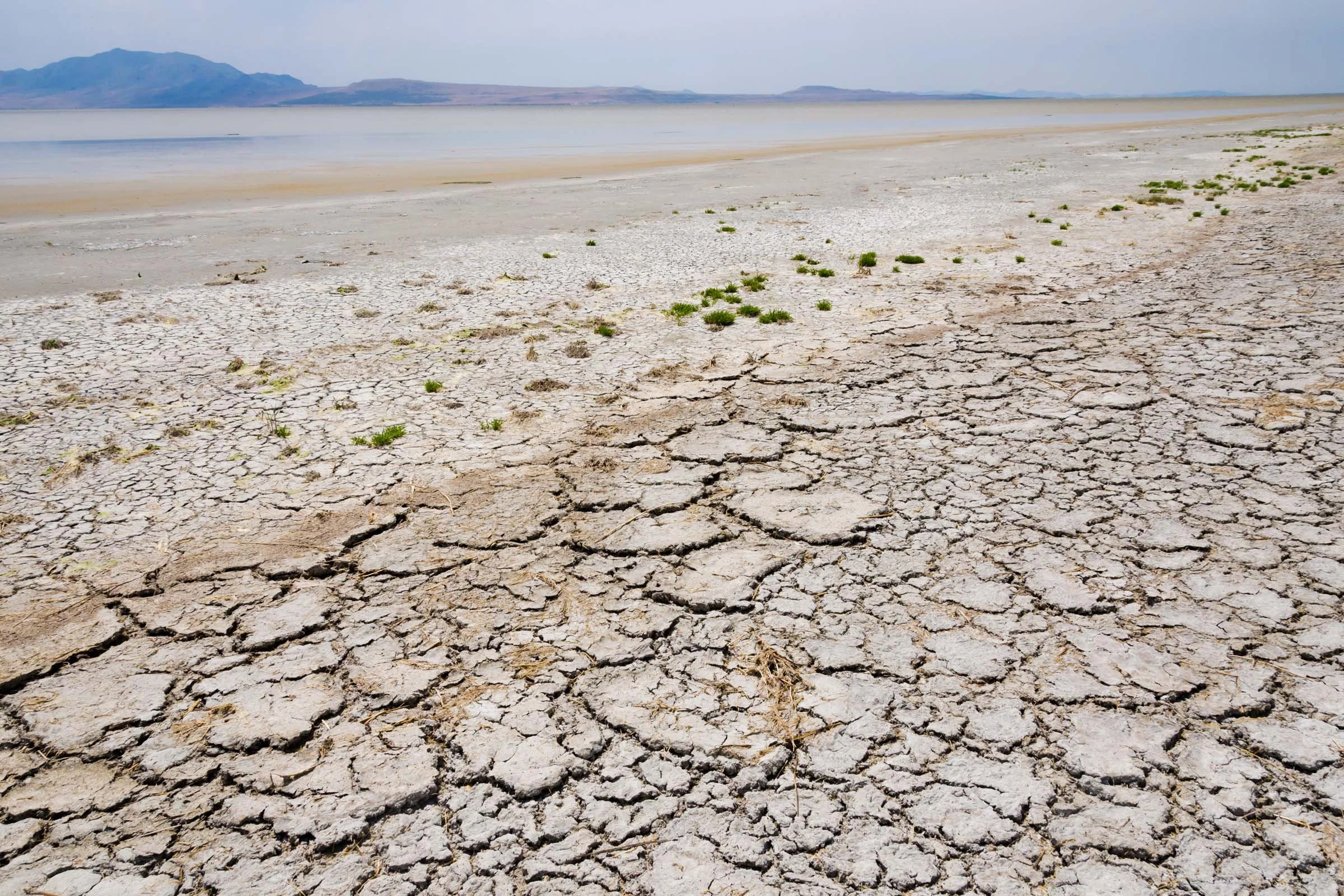
What the Lakebed Leaves Behind
As water levels have dropped over the past two decades, the lake has exposed hundreds of square miles of its former floor. That dry, cracked lakebed — called a playa — doesn't just sit quietly. When wind moves across it, it carries sediment into the air over Salt Lake City, Ogden, Provo, and every community in between.
By 2020, exposed Great Salt Lake lakebed was estimated to contribute roughly 23 to 34 percent of all dust flowing through the Wasatch Front airshed. And as water levels have continued to fall since then, that number has almost certainly grown.
This dust isn't simple sand. Great Salt Lake sediment contains metals, salts, natural and human-made chemicals, and bacteria. The lakebed carries the accumulated legacy of more than a century of mining runoff, agricultural outflows, and wastewater discharge — all of it locked in sediment that was safely underwater until recently. Researchers have tested dust samples for arsenic, lead, and cadmium — all classified as priority pollutant metals.
How Dust Gets Into Your Body
Not all airborne particles are equal. Scientists track two main sizes — PM10 and PM2.5 — and both matter here.
PM2.5 particles, 2.5 micrometers or less in diameter, are so small they can travel deep into the lungs and other human tissues. PM10 particles — up to 10 micrometers — are larger, but roughly half of what's inhaled still ends up in the lungs.
Great Salt Lake dust consists of six times more PM10 than PM2.5 — meaning the coarser, larger particle is the dominant concern, yet it's the one the state is monitoring least effectively.
What Researchers Are Finding
University of Utah pharmacologist Dr. Christopher Reilly and his team have been studying what happens when this dust enters the body. Their study, published in the journal Particle and Fibre Toxicology, found that inhaled lakebed dust triggers inflammation in the lungs.
Reilly's assessment of what his team found was striking. He noted that Great Salt Lake dust produced broader effects at lower exposure levels than other pollutants his group has studied, including coal ash, wood smoke, and diesel particles.
That dust carries the potential to cause lung irritation, cardiovascular disease, gastrointestinal problems, and cancer — though researchers are careful to note that the full scope of long-term health risk is still being quantified.
There's also a neurological dimension that hasn't received much public attention. Studies have identified cyanotoxins in the airborne particles above the lake, including a neurotoxin called BMAA, chronic exposure to which has been linked to ALS. While measured airborne levels were not high enough to cause acute toxicity, researchers have flagged the potential for chronic toxicity over time, and the possibility that multiple toxins in combination could amplify each other's effects.
A Monitoring Gap and Progress
The Utah Division of Air Quality has made progress on a long-standing monitoring gap. Four new PM10 filter monitors have been installed at locations closer to the lake — including Lake Park, the Prison site, and Brigham City — with an additional monitor at Bountiful Viewmont increasing sampling frequency from every six days to daily. In June 2025, the state announced plans to expand the network to 19 monitors total, with some offering continuous real-time data and others collecting dust samples for lab analysis.
Still, Dr. Perry has publicly raised concerns that the state's plan may not meet federal standards — warning that spending $1 million on infrastructure that falls short of federal protocols would be a missed opportunity. The monitoring picture is improving. But Perry's core question remains: do we yet have the data to know how bad this really is?
Who Is Most at Risk
A University of Utah study led by sociology professor Sara Grineski found that dust from the lakebed disproportionately affects disadvantaged neighborhoods in Salt Lake County. Research along the Wasatch Front, where 80 percent of Utah's population lives, has documented both long- and short-term particulate matter exposure disparities by race and ethnicity.
Children, the elderly, and anyone with existing respiratory or cardiovascular conditions face elevated risk during dust events — which tend to spike in spring and fall when wind patterns shift across the valley.
What You Can Do Now
The Utah Division of Air Quality recommends checking the Air Quality Index at air.utah.gov before outdoor activity, particularly on windy days when dust events are more likely. Researchers advise refraining from exercise during dust storms and considering an N95 or KN95 mask when outdoors on high-dust days.
The federal government's new $1 billion commitment to the Great Salt Lake — announced this week by the Trump administration — offers a potential turning point. But the lake's decline happened over decades. Its recovery, and the reduction of its dust threat, will take sustained investment, water policy reform, and time.
In the meantime, the wind keeps blowing.
→ Next issue of Great Lake Watch: Where does the lake's water actually come from — and who controls it?
(This article was produced with AI research assistance and has been reviewed and edited for accuracy. Sources are listed below.)Sources
Utah Division of Environmental Quality, Great Salt Lake Dust and Air Quality: deq.utah.gov
University of Utah College of Pharmacy, "Breathing Great Salt Lake Dust," January 2026
Particle and Fibre Toxicology, Reilly et al., January 2025
U.S. Geological Survey, "Dust from the Great Salt Lake Dry Lakebed," 2025
Great Salt Lake Collaborative / Salt Lake Tribune, "Utah received money to study the harmful effects of Great Salt Lake dust. It just hasn't spent it," July 2024
Johns Hopkins American Health, "Public Health Impacts of a Drying Saline Lake," December 2024
Atmospheric Environment, University of Utah KairLab dust oxidative potential study, 2024