

A Quote Is Not A Policy
Utah is burning through a record fire year. If you are buying, refinancing, or shopping your homeowners coverage, the window to lock in a rate can close overnight — and almost nobody sees it coming.
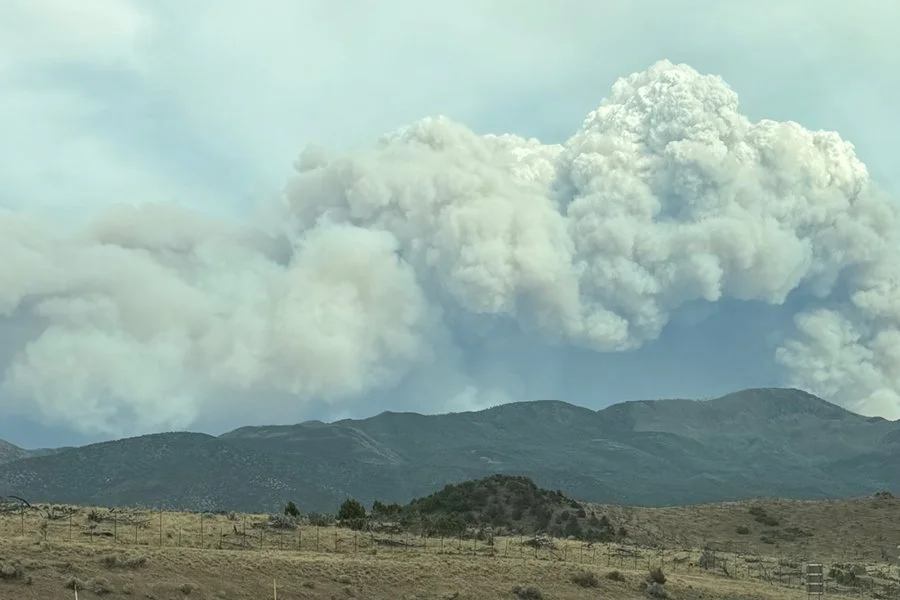
Beaver fire burns on June 26, 2026 as seen from I-15 in Beaver, Utah. (Photo by Mountain & Main Staff)
Here is a scenario that plays out every summer in Utah, and it has nothing to do with flames reaching your street:
You've been meaning to shop your homeowners insurance. Rates have gone up, a neighbor mentioned they found something better, and you finally get a quote you like on a Tuesday. You tell the agent you'll think it over. On Thursday, a fire starts in the mountains twenty miles away. On Friday, the carrier stops writing new business in your ZIP code.
The quote is gone. Not because anything changed about your house. Because of a line on a map and a fire you can only see as haze on the horizon.
This is called a moratorium, and in a year like this one, Utah homeowners should understand exactly how it works.
The year the math broke
By early July, wildfires had burned more than 357,000 acres across Utah — more than the previous five years combined.
The Cottonwood Fire, which ignited east of Beaver on June 22, grew past 10,000 acres in its first day and eventually burned more than 97,000. It destroyed at least 150 structures, including cabins that had been in families for generations, and stands as the sixth largest fire in state history. The Babylon Fire in San Juan County pushed past 100,000 acres — the first Utah fire that size since 2018. Governor Cox ordered a temporary statewide fireworks ban ahead of the Fourth, calling it "a temporary measure for an extraordinary year."
Insurance carriers watched all of that too. And they responded the way they always do.
What a moratorium actually is
When a wildfire is burning near a given area, carriers frequently stop writing new business there. They pause. No new policies, no increases to existing coverage, no switching to their book from a competitor — often defined by ZIP code, often for as long as the fire is active and uncontained.
This is not a punishment and it is not a scandal. It exists to prevent a very specific problem: someone watching a fire crest a ridge, realizing they are underinsured, and buying coverage that afternoon. Insurance prices risk in advance. It cannot price a fire that has already started.
Moratoriums are temporary. They lift once conditions normalize. In a normal year, most homeowners never learn they happened.
This is not a normal year.
"Wildfire moratoriums are one of the least understood parts of homeowners insurance. We never like telling someone that the policy they wanted is no longer available because conditions changed before we could bind coverage. That's why we encourage homeowners to review their policies annually and shop early, before wildfire activity increases," said Chris Durling, Agency Owner, Mountain View Insurance.
The three ways it costs you
1) You are buying a home. Nearly every mortgage lender requires proof of homeowners insurance before funding. If your carrier has paused new business in the area where you're purchasing, you may not be able to bind a policy on the timeline your contract assumes. That is a closing delay you did not budget for, over something entirely outside your control — and in a market this tight, delays have consequences.
2) You are refinancing. Same requirement, same exposure.
3) You are shopping your coverage. This is the one that catches the most people, and it's the least understood. A quote is a carrier's offer. A policy is a contract. Between those two things is a gap, and the gap is where the risk lives. A carrier writing competitive business in Bountiful on Monday can pause the entire area on Thursday because a fire started Wednesday night. Your quoted premium was never guaranteed. Neither was your ability to buy from that carrier at all.
So: when you have done the comparison, when you understand the coverage, and when you have decided — bind it. Not because anyone is pressuring you. Because the thing you are deciding about may not be available to decide about next week.
Which leads to the more useful version of the same advice: shop in March, not in July. The best defense against a moratorium is not needing to buy anything while one is in effect.
Utah's new rulebook
Where this stops being a national story and becomes a Utah one is HB 48, passed in the 2025 legislative session and effective January 1, 2026.
It draws a line. The Division of Forestry, Fire and State Lands built a statewide High-Risk Wildland-Urban Interface boundary, weighing vegetation, topography, ember-travel potential, wildfire likelihood, and how closely structures sit to one another. Roughly 60,000 structures statewide fall inside it, largely foothill and canyon-adjacent neighborhoods. Look up your address at wildfirerisk.utah.gov.
It attaches a fee. Structures inside the boundary are assessed an annual wildfire mitigation fee on the property tax bill. For 2026 and 2027 it's a flat $20 to $100 per structure based on square footage. From 2028, the fee ties to a "triage score" from a lot-level assessment — so homeowners who do the mitigation work can lower what they pay. Owners who decline an assessment are charged at the highest tier.
It requires insurers to explain themselves. Carriers must use the state's boundary when evaluating wildfire risk, and disclose when a premium rises more than 20 percent or coverage is discontinued for wildfire reasons.
That last provision is the quiet win. For years the standard experience was a rate hike or a non-renewal letter that explained nothing, generated by a proprietary model the homeowner could not see or question. HB 48 doesn't promise a better answer. It promises an answer.
What to actually do
Look up your address. wildfirerisk.utah.gov. Know whether you're inside the high-risk boundary before your carrier tells you.
Shop in the spring. March is a better month to review coverage than July. The whole moratorium problem is avoidable if you are not shopping during fire season.
When you decide, bind. Don't let a quote sit for three weeks in August.
Check your dwelling limit, not just your premium. The number that matters is what it costs to rebuild your house at today's construction prices — not what you paid, not what you set five years ago. Underinsurance is the most common and most expensive mistake in a total loss.
Read your loss-of-use coverage. If you're evacuated for two weeks, who pays for the hotel? Standard policies generally cover direct fire and smoke damage. Additional living expenses during an evacuation vary considerably.
Do the mitigation work, and document it. Class A fire-rated roofing. Defensible space. Ember-resistant vents. Dated photos, saved invoices. From 2028 that documentation lowers your state fee — and it is your evidence when you contest a rate increase.
If you're non-renewed, move immediately. You typically have 30 to 60 days before it takes effect. Ask your agent to review your whole account, too — a home non-renewal can drag auto and umbrella coverage with it when everything is bundled with one carrier.
If you believe you were treated unfairly, the Utah Insurance Department takes consumer complaints. That is what it is there for.
The bottom line
Moratoriums are a small mechanism inside a much larger shift. Utah's insurance market has finished re-pricing wildfire risk, the state has put its own map on the table, and the cost of living in the beautiful part — the foothill lot, the canyon road, the house that backs to open space — now shows up on a bill.
The market does not wait for you to finish thinking. In a summer like this one, the difference between a policy and a problem can be the week you took to decide.
The state's own line on all of this is worth repeating, because it happens to be true: the best firefighter is the homeowner, before the fire starts. Defensible space and a hardened roof don't just improve your odds in a fire. In 2026, they're increasingly what keeps you insurable. If you haven't reviewed your homeowners insurance recently, now is the time. Whether you're buying a home, renewing your policy, or simply wondering if your current coverage is still the right fit, reach out to the team at Mountain View Insurance (801-999-2667) for a proactive review today. It could help you avoid unexpected surprises tomorrow.
Tap These Ads to Learn More…



Sources
• Utah Fire Info / National Interagency Fire Center, acreage data via KUER, July 7, 2026
• Cottonwood Fire size, structure loss, and historical ranking, via Salt Lake Tribune and ABC4, June–July 2026
• Utah Division of Forestry, Fire and State Lands — HB 48 FAQ and Wildland-Urban Interface program: ffsl.utah.gov
• Utah Wildfire Risk Assessment Portal: wildfirerisk.utah.gov
• Utah HB 48 (2025 General Session), "Wildland Urban Interface Modifications"
• Utah Insurance Department, statement on wildfire coverage availability, via KUTV, June 2026
• Utah Insurance Department premium data, via ABC4, April 2026
• Utah Insurance Commissioner Jon Pike, interviews with ABC4 and KUTV, 2025–2026
• California Department of Insurance mandatory moratorium following the Palisades and Eaton fires, January 2026
• Office of the Governor, statewide fireworks restriction announcement, June 2026
• U.S. News & World Report, Utah homeowners insurance market overview, June 2026
Mountain & Main is a general-interest publication. This article is reporting, not insurance advice. Questions specific to your property should go to a licensed agent or to the Utah Insurance Department.
AI assistance was used in the research and drafting of this article. All facts were verified against the sources listed above.