

Utah’s War on Drought
Drying Out and Digging In: The Real Cost of the Great Salt Lake Crisis—and How We're Fighting Back
By Tyler Tebbs Publisher, Mountain & Main Magazine
Living on the Wasatch Front means living with a climate rhythm that leans dry. Utah has faced chronic drought conditions throughout most of its modern history, and the pattern has only intensified in recent decades. But recently, the conversation has shifted from yellowing lawns to a full-blown existential crisis for our defining landmark: the Great Salt Lake.
The lake has reached historically low water levels over the last few years due to a combination of reduced streamflows, increased evaporation, and human water consumption. As the water recedes, we are forced to confront what a shrinking lake really means for our local economy, our health, and the future of the Salt Lake Valley—and more importantly, what we are actually doing to fix it.
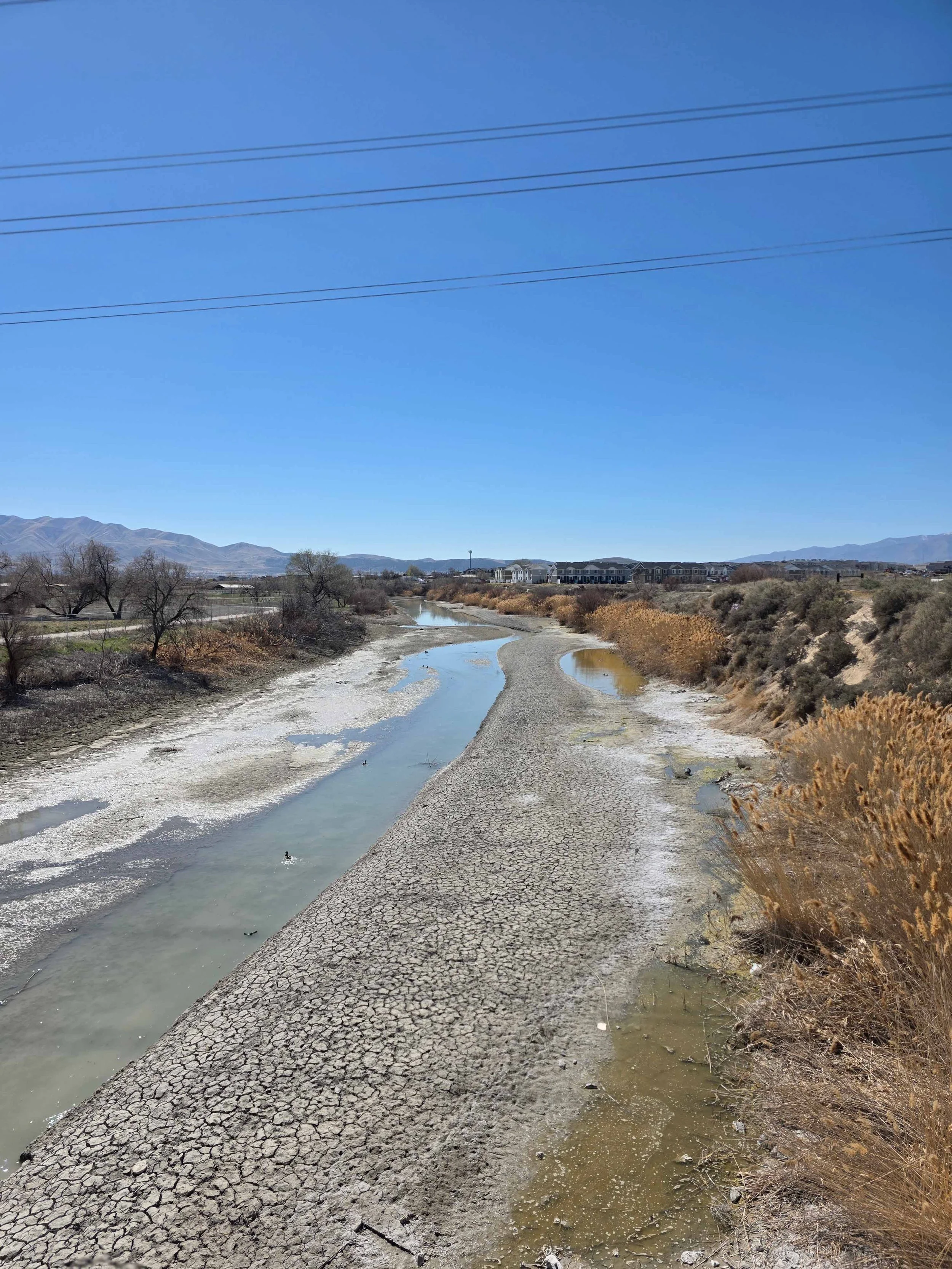
“The Drought Isn’t Going Anywhere”
The Jordan River near Lehi, photographed March 2026 — flows that should be rising with snowmelt tell a different story. (Photo by Mountain & Main Staff)
The Economic and Health Stakes
This isn't just about losing a pretty sunset reflecting off the water. The shrinking lake presents a significant ecological threat to northern Utah.
The economic engine of the Wasatch Front relies heavily on the "lake effect" snow that fuels our world-class ski industry and buffers our water supply. More than 95% of Utah's water supply starts as snow. When the lakebed dries up, we also risk hazardous dust—potentially containing heavy metals like arsenic—blowing into our communities, which could heavily disrupt the habitability of the Salt Lake Valley and trigger severe respiratory issues.
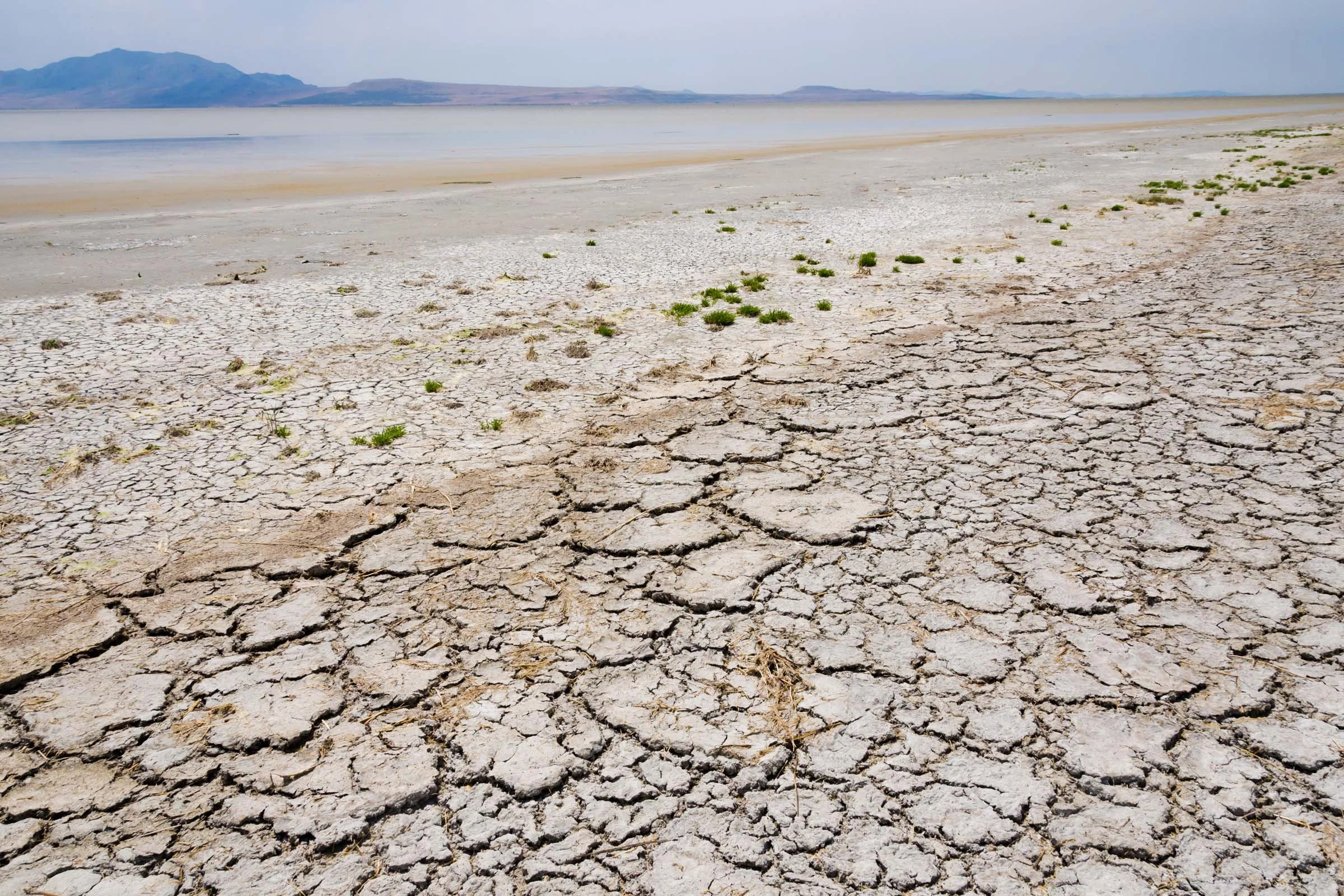
More than 95% of Utah's water supply starts as snow. When the lakebed dries up, we also risk hazardous dust. (Photo by amenohi at Adobe Stock)
The Pacific Pipeline: Why It's a Pipe Dream
When the lake hit its all-time low, some wild ideas were floated to save it—most notably, building a pipeline to pump seawater from the Pacific Ocean to the Great Salt Lake. While it sounds like a silver bullet, the math simply doesn't work.
The Cost: Researchers estimated it could cost over $100 billion just to design and construct.
The Energy: A study by Brigham Young University found that pumping water roughly 550 miles inland with an elevation gain of 4,200 feet would require 400 megawatts of electricity—roughly 11% of Utah's entire annual electricity demand. Critically, that staggering energy cost would move only about one-third of the water the lake actually needs to recover. A full restoration scenario would require far more.
The Fallout: Operating the system would cost over $300 million annually and emit nearly one million metric tons of carbon dioxide each year, equivalent to the emissions of 200,000 passenger vehicles.
In short, the pipeline would be breathtakingly expensive, environmentally damaging, and still fall drastically short of saving the lake.
Real Solutions on the Ground
Instead of exotic megaprojects, the focus has to remain inside our own watershed. The data points clearly to where the water is going: agriculture accounts for about 65% of the lake's depletion since 2020, while municipal and industrial use makes up over a quarter of the total—a share that is rising as the Wasatch Front continues to grow.
To combat this, Utah has launched hundreds of agricultural optimization projects to improve irrigation efficiency across the state. For valley residents, the mandate remains to use water wisely year-round, such as delaying lawn watering until mid-May following good winters and utilizing the state's conservation resources.
Looking to the Skies: Utah's High-Tech Cloud Seeding Expansion
If you're wondering whether we can just make it rain—or snow—the answer is yes. Utah isn't just participating in weather modification; we are now operating the largest remote-controlled cloud seeding program in the United States.
While Utah has been cloud seeding since the early 1950s, the state recently took the program from a modest regional effort to a massive, high-tech operation. Recognizing its immense value in fighting drought, the Utah State Legislature dramatically increased the program's budget—from roughly $200,000 in 2022 to nearly $16 million recently.
Here is what that money is doing in our skies right now:
A Massive Automated Network: The state recently deployed 190 remotely operated ground-based generators, placed along foothills and high elevations. These machines release silver iodide—a synthesized compound that has been thoroughly studied and is not known to be harmful to the environment, humans, or wildlife—into winter storm clouds. The silver iodide provides a particle for supercooled water to bond to, creating ice crystals and accelerating snowfall.
The Drone Fleet: Utah is moving beyond traditional airplane seeding and has launched a pioneering experimental drone program. These drones can fly directly into storm clouds in challenging terrain—like the La Sal Mountains in southeastern Utah—to release seeding material at the optimal temperature for ice crystal formation.
SNOWSCAPE 2026: To better quantify the science, Utah has launched SNOWSCAPE—Seeded and Natural Orographic Winter Storms Catchment Processes and Evaluation—a major research program partnering with the University of Utah, Utah State University, and the National Center for Atmospheric Research. Using laser-based instruments, mobile radar, and atmospheric sensors deployed across the northern Wasatch Range, the program will collect high-resolution data to calibrate cutting-edge models that will rigorously measure how much additional snowpack the seeding program is generating. Researchers caution that results won't be published for at least two years—but early findings could shape Utah's water management decisions for decades.
The Results: State engineers report that the program currently yields a statewide average snowpack increase of 10.4%, essentially squeezing extra "juice" out of existing winter storms. Longer-term independent research estimates cloud seeding enhances snowpack in targeted areas by 3–13%, which may sound modest but accumulates significantly over time—the equivalent of an additional half-year to a full year of snowpack over the course of a decade.
Engineering a Winter Wonderland for 2034—and What Russia and China Can Teach Us
With Salt Lake City officially hosting the 2034 Winter Olympics, a natural question arises: Is Utah intentionally building toward a guaranteed white winter for the global stage?
The Utah Division of Water Resources officially designates the cloud seeding expansion as a long-term water management strategy aimed at drought mitigation and saving the Great Salt Lake. But the secondary benefits are undeniable. Our ski industry relies on the "Greatest Snow on Earth," and a reliable, heavy snowpack is the absolute prerequisite for a successful Winter Games.
History offers a sobering reminder of what happens when host nations don't have Utah's natural advantages—and how far other countries have gone to compensate.
For the 2014 Winter Olympics in Sochi, Russia faced a geographic absurdity: hosting a snow-dependent Winter Games in a subtropical Black Sea resort where February temperatures routinely climb into the mid-40s Fahrenheit. Determined not to fail on the world stage, Russian organizers launched what they called the "Guaranteed Snow" programme. They deployed more than 500 snowmaking guns fed by two specially constructed water reservoirs, and spent the entire preceding year stockpiling an estimated 710,000 cubic meters of natural and machine-made snow in insulated mountain storage areas—snow preserved from the prior winter season, held in reserve against the possibility of a warm February. Cloud seeding, a technique with roots going back to Soviet times, was also deployed to redirect rain clouds away from competition venues. The total cost of the Sochi Games, including all snow and infrastructure, reached an estimated $50 billion.
China's approach to the 2022 Beijing Winter Olympics was even more dramatic—and has no precedent in Olympic history. The mountains surrounding the Beijing venues receive only a few inches of snowfall per winter month. Rather than search for a snowier alternative, China became the first nation in history to host a Winter Olympics on 100 percent artificial snow. More than $60 million was spent on snow machines alone, consuming an estimated 49 million gallons of water to blanket the courses for competition. The Beijing Weather Modification Office—a government agency with a staff of 37,000 nationwide—simultaneously conducted cloud seeding operations and deployed weather modification technology to control air quality and precipitation patterns during the Games.
The contrast with Utah could not be sharper. Russia and China had to manufacture their Olympic winters from scratch, at staggering expense, in climates that fundamentally cannot produce natural snow on demand. Utah's mountains already deliver some of the most abundant natural snowfall on the planet. What our cloud seeding program is building isn't a workaround—it's an amplifier.
By investing millions into weather modification infrastructure a decade ahead of the 2034 Games, Utah is effectively constructing an insurance policy built on what nature already provides. We aren't hoping for good weather when the world arrives in 2034. We are actively enhancing the conditions that make our mountains legendary—and we're doing it with a technology refined over 70 years, not improvised under the pressure of a looming opening ceremony.
The Road Ahead
The drought isn't going anywhere, but neither are we. By blending heavy investments in agricultural efficiency, smarter municipal water use, and cutting-edge weather modification, we are fighting to keep the Great Salt Lake alive, our economy thriving, and our slopes perfectly powdered for 2034. The nations that came before us built snow out of thin air and spent tens of billions proving it can be done. Utah is taking a different path—working with the mountains we have, the storms that already come, and a growing arsenal of tools to make every flake count.
( This article was produced with the assistance of artificial intelligence tools. Statistical claims, source attributions, and factual content have been reviewed and verified by Mountain & Main Magazine's editorial team prior to publication. )