

Spring Came Early to the Wasatch. The Lake Got Nothing.
The Great Lake Watch
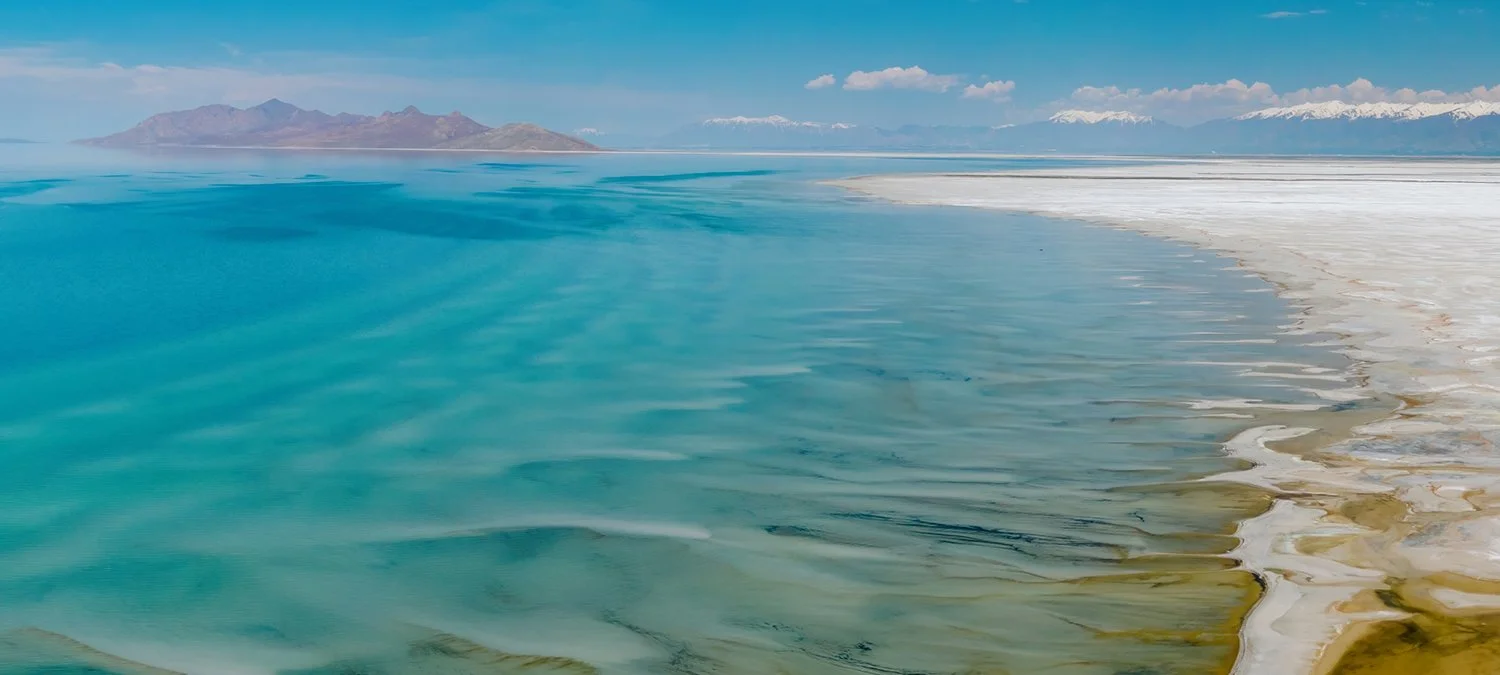
Shoreline of the Great Salt Lake. (Adobe Stock Photography • By Zenstratus)
The window that opens once a year to refill the Great Salt Lake has already closed — and it's only mid-April.
By Cal Tebbs
There is one moment each year when the math can work in the Great Salt Lake's favor.
It comes in spring. Snow that has been accumulating in the Wasatch and Uinta ranges since October begins to melt. Water moves downhill — into the Bear River, the Weber, the Jordan — and eventually finds its way to the lake. Levels rise. Not dramatically, not enough to reverse decades of decline in a single season, but enough to matter. Enough to give the lake a fighting chance before summer heat evaporates whatever it gained.
That window opened this year on March 9.
It closed, for all practical purposes, around the same time.
The Snowpack That Wasn't
Utah's mountain snowpack is measured in snow water equivalent — the amount of liquid water locked inside the snowpack at any given moment. In a normal year, that number climbs steadily from October through the first week of April, when it typically peaks somewhere around 17 inches statewide before the melt begins in earnest.
This year, Utah's snowpack peaked at 8.4 inches. On March 9. Three weeks before it was supposed to.
The Utah Division of Water Resources confirmed in its March 19 update that this was the lowest snowpack peak on record for the state — roughly half of what the Wasatch mountains normally hold at the start of April. The winter that produced it was the warmest on record by 2.2 degrees Fahrenheit, dating back to 1874. Salt Lake City alone surpassed its previous warmth record by more than seven degrees.
What didn't fall as snow often fell as rain — and rain doesn't accumulate in the mountains, waiting to release slowly into rivers through May and June. It runs off fast, or evaporates, and does very little for the lake.
By the time March ended, 98% of the state was in some form of drought.
What This Means for the Lake Right Now
The Great Salt Lake was already in a precarious position heading into this winter. Scientists have established 4,198 feet above sea level as the minimum elevation at which the lake functions as a healthy ecosystem — enough water to support the brine shrimp, the migratory birds, and the salinity balance that keeps the lakebed crust intact.
As of April 9, 2026, the lake sat at 4,192.3 feet. Nearly six feet below that threshold.
It had, quietly, already broken its own historical record. According to the Utah Division of Water Resources, the southern arm of the lake dropped below the previous all-time low set in 1963 earlier this winter. The USGS, which has maintained lake elevation records dating to 1847, projects the lake could lose an additional foot of elevation before the year ends.
In a normal spring, lake levels don't peak until late May. This year, that peak has already come and gone — confirmed by reporting from KUER's RadioWest as recently as April 13. The melt was too thin, too fast, and too early to move the needle in any meaningful way.
The River Math
The Wasatch Front's three primary tributaries — the Bear River, the Weber River, and the Jordan River — are the arteries that carry snowmelt to the lake. When snowpack is strong, those rivers run high through April, May, and into June, delivering sustained inflow that the lake can absorb.
This spring, stream flow projections across Salt Lake City's Wasatch water service area came in at 50 to 60 percent of average — and that figure was cited when Mayor Erin Mendenhall declared a Stage 2 drought advisory in March, the city's first since October 2022. The Colorado Basin River Forecast Center's April–July runoff projections for Utah are below average, with weather forecasts suggesting snowmelt will now outpace any new snowfall the state might receive.
In plain terms: the rivers aren't carrying enough water, and what little they are carrying is already moving.
What the Legislature Did — And What It Means for Your Yard
Utah's 2026 legislative session wrapped up on March 6, and water was the dominant theme. The session produced several bills with direct implications for the Great Salt Lake — and, more immediately, for the yards and irrigation systems of the families who live along the Wasatch Front.
The most significant piece was HB410, which created a formal water leasing program that pays farmers to send water downstream to the lake rather than using it to irrigate their crops. The concept is straightforward: a farmer along the Bear River or Weber River who decides not to irrigate a field this season gets paid by the state — roughly $300 per acre-foot — and that water flows toward the lake instead of onto the land. The closer a farm sits to the lake, the more the state will pay, because proximity increases the odds the water actually arrives. The legislature funded the program with nearly $3 million to start. It's real money with real mechanics behind it. The catch: the program doesn't launch until 2027, which means it won't help the lake this summer.
A companion bill, HB348, cut through the bureaucratic timeline that previously made water leasing agreements impractical for farmers trying to make season-by-season decisions. Where a single lease agreement once took six months to a year to process through the state engineer's office, the new law brings that down to six weeks. That speed matters — a farmer deciding in May whether to lease or irrigate can't wait until November for an answer.
A separate bill, SB46, requires state government facilities to shut off overhead spray irrigation during daytime hours and during rainstorms — a change aimed at the thousands of acres of publicly maintained turf across the state. The bill also recommends that state agencies begin replacing water-intensive grass with native plants and drought-tolerant landscaping. That mandate applies to government properties, not private homes. But the underlying math applies to everyone.
Here is why it matters to you directly.
If you own a home along the Wasatch Front, there is a reasonable chance your yard is one of the most water-intensive features of your property. Sixty percent of residential water use in Utah goes toward outdoor irrigation — and the majority of that is grass. A traditional bluegrass lawn in this climate requires roughly 50 to 75 inches of water per year to stay green, in a region that receives about 15 inches of annual precipitation. Everything else comes from your sprinkler system, drawn from the same watershed that feeds the Great Salt Lake.
That doesn't mean you need to give up your yard. It means the state will pay you to change part of it.
Utah's Landscape Incentive Program — which predates this year's legislative session and is active right now — pays homeowners $2 per square foot of grass removed and replaced with water-efficient landscaping. A modest park strip conversion of 200 square feet returns $400. A more substantial side or front yard project can run into thousands of dollars back in your pocket, up to a maximum of $50,000 per application.
The program is available to homeowners in most Wasatch Front communities, including Salt Lake City, Sandy, Draper, Murray, West Jordan, Riverton, South Jordan, Millcreek, Taylorsville, West Valley City, Bountiful, Farmington, Kaysville, Clearfield, Roy, Herriman, Holladay, and Cottonwood Heights, among many others.
The one rule that matters most: Do not remove or kill your grass before applying. Doing so disqualifies you from the program. Apply first, get approval, schedule the site visit, then proceed. Applications are processed at utahwatersavers.com, where you can enter your water provider to confirm eligibility and see what your community specifically offers.
The state is trying to solve a water problem that is, at its scale, almost incomprehensibly large. But it is also offering Wasatch Front homeowners a straightforward transaction: convert some of your lawn, get paid to do it, lower your water bill in the process, and put real water back into the system that keeps this valley livable. That is not a sacrifice. That is a reasonable deal.
What Comes Next
The situation has drawn federal attention. President Trump's budget proposal to Congress included a request for one billion dollars directed at the Great Salt Lake's long-term sustainability — a commitment that BYU ecosystem ecologist Ben Abbott, speaking on KUER's RadioWest this week, described as a significant opportunity, while noting the real challenge will be translating funding into actual water in the lake.
For now, what is clear is this: the lake's annual window has closed, and it closed with the lake near the lowest elevation in recorded history. Summer evaporation rates on the Great Salt Lake average several feet per year. Without meaningful inflow to offset that loss, the lake will be lower in October than it is today.
The snow is gone. The water didn't make it. And the calendar says it's only April.