

The High-Velocity Collision of Cowboy and Carve
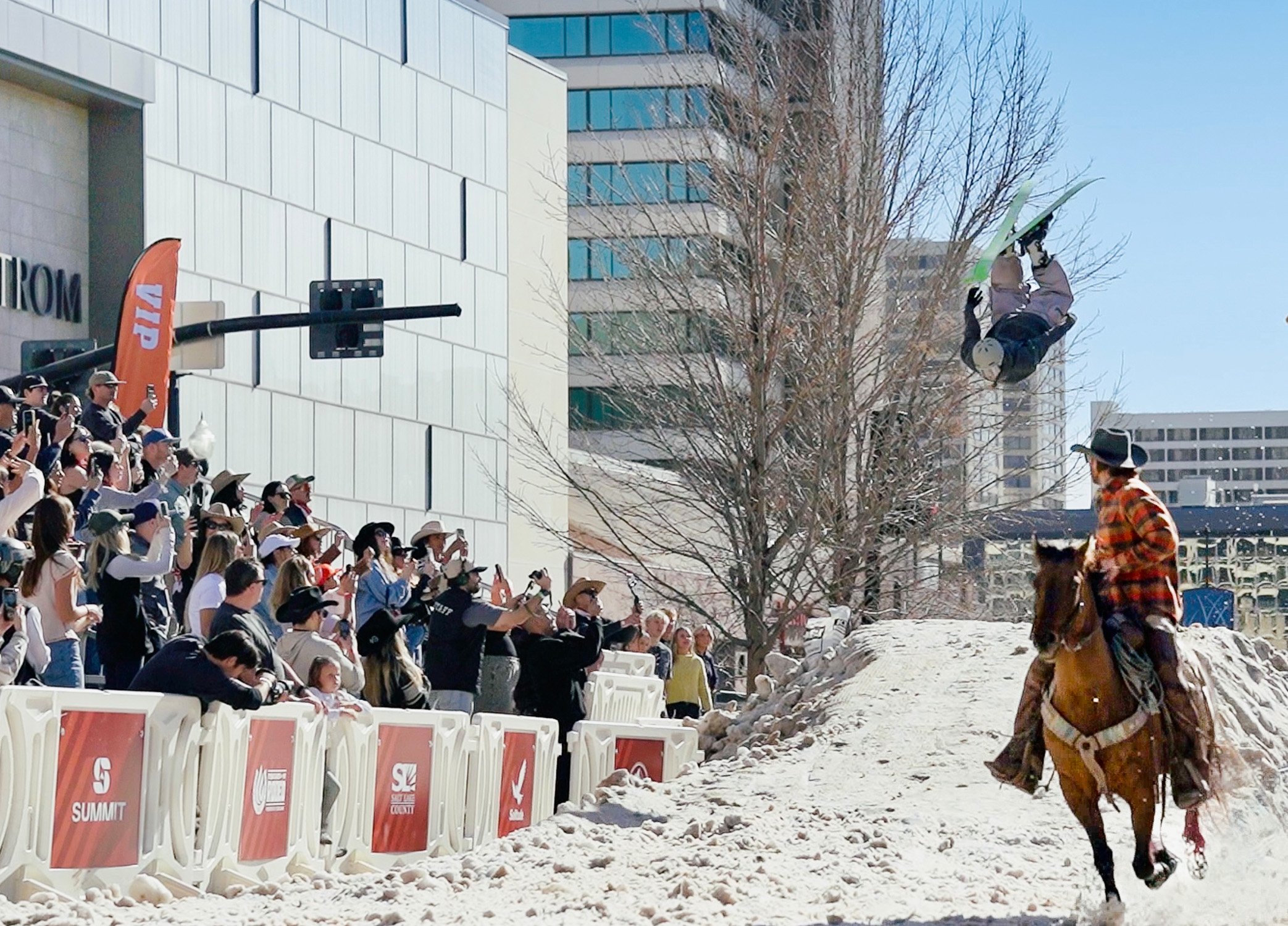
If you were standing on West Temple Street in downtown Salt Lake City on the right afternoon this past January you heard something that doesn't quite compute. It isn't traffic. It isn't a parade. It was the rhythmic, percussive thunder of a Quarter Horse at full gallop, the snap of a tow rope going taut, and the sharp shush of skis cutting through hard-pack snow hauled in by the truckload. A skier launches off a kicker and goes airborne — six, eight, ten feet above the street — while a cowboy in a flannel shirt navigates the course below, office towers and a crosswalk signal framing the whole improbable scene.
Welcome to skijoring. And yes, it's exactly what it looks like.
Roots, Reinvented
The word comes from the Norwegian skikjøring — "ski driving" — a utilitarian mode of winter transport that Scandinavian farmers and soldiers used for centuries. What arrived in the American West shed the utility entirely and kept only the adrenaline. The modern competitive format traces its roots to Leadville, Colorado, where the obstacle-course structure was formalized in 1949, adding slalom gates, jumps, and the precision-testing ring grab to the raw speed of horse and skier.
The sport is built around a "competitive trinity": horse, rider, and skier. Teams regularly hit 40 miles per hour, with the skier managing the tension of the rope, threading gates, and launching off kickers — all while a 1,200-pound Quarter Horse accelerates away in front of them. The physics are unforgiving, the margin for error measured in inches.
"It's a dance of trust," says one veteran rider on the circuit. "The horse has to ignore the chaos behind them, the rider has to hold the line, and the skier just has to hold on for dear life."
The Wasatch Front Is All In
Utah has become one of the sport's most important stages. The 2026 PRO Skijor Frontier Tour — with a total season payout exceeding $250,000 — has made the Wasatch Front a centerpiece of its circuit, with events drawing massive crowds in Heber City and Logan before the tour's championship finale brought the sport into the urban heart of Salt Lake City itself.
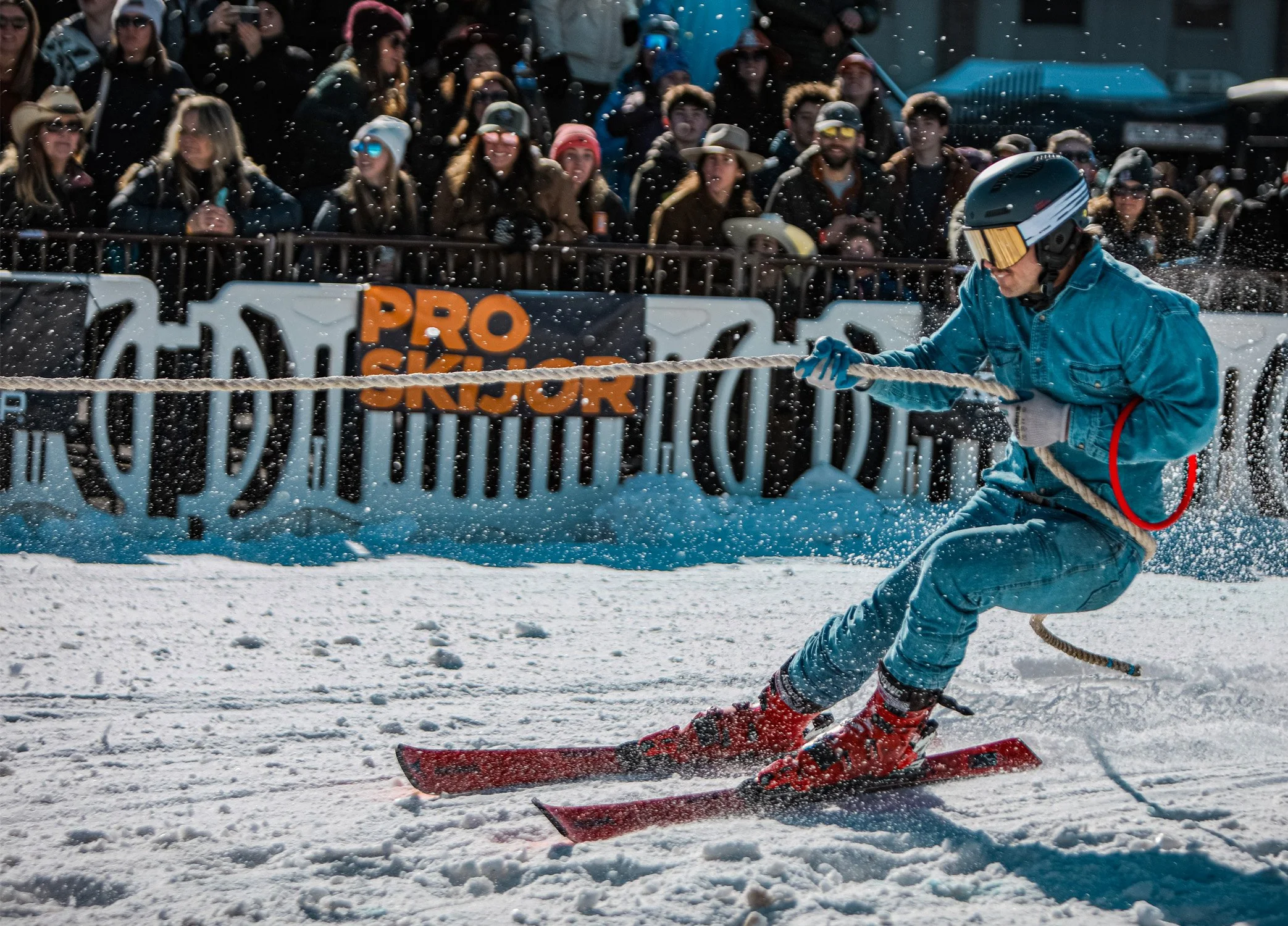
“…As soon as that horse starts to kick it into drive, the rope wants to pull you directly behind it — fighting that pull to stay on course was a unique experience. But once I'd get up to speed, it felt like home," said freestyle skier Koby Barlow.
That downtown event was a statement. Organizers trucked in snow, built a course on West Temple, and turned a city block into a rodeo-ski hybrid spectacle that stopped pedestrians in their tracks. Bleachers packed out. Phones went up. The Salt Lake County seal on the barrier boards made it official — this wasn't a novelty act passing through. This was a city claiming a sport.
Freestyle skier Koby Barlow made the transition from backcountry big mountain riding to the skijoring course and found the two worlds weren't as far apart as they looked. "I've grown up in high elevation riding big mountain and touring backcountry, but skijoring was a completely new world," he says. "It's intimidating being on a narrow path getting towed by these horses. As soon as that horse starts to kick it into drive, the rope wants to pull you directly behind it — fighting that pull to stay on course was a unique experience. But once I'd get up to speed, it felt like home."
The trust between skier and rider, Barlow discovered, is built fast out of necessity. "My first attempt was a little slow, so for my second, a rider came by asking who wanted a fast horse. I raised my hand and he said, 'Come on, let's do it.' Man, did he throttle it."
The championship finale moved to the mountains — where the snow problem solved itself — and the setting produced the kind of imagery that stops a scroll cold: skiers launching full layouts off kickers with snow-dusted peaks filling the frame behind them, crowds packed three and four deep along the rails, and a podium ceremony that looked equal parts rodeo buckle presentation and ski race celebration. Chaps, helmets, babies, and prize checks — all of it somehow fitting together perfectly.
The Climate Argument
There's a deeper conversation running underneath all of it, and it matters in Utah right now. With some mountain weather stations recording just 32 to 42 percent of normal snowpack in 2026, traditional alpine resorts are navigating a difficult season. Skijoring doesn't need a mountain. It doesn't need deep powder. It needs a flat stretch of packed snow, a rope, and a willing horse — and in a drought year, that's a significant competitive advantage over almost every other winter sport on the calendar.
Barlow sees it plainly: "I think in these rare cases of poor snowfall, falling back on skijoring is one of the best options. I believe these events will have bigger turnouts each and every year."
That resilience has not gone unnoticed. As Utah prepares to host the 2034 Winter Olympics — awarded to Salt Lake City by the IOC in July 2024 — the question of which sports best represent the evolving Western winter identity is already being asked in planning circles. Skijoring is not currently an Olympic discipline, and no formal proposal exists to make it one. But the sport's combination of athleticism, spectacle, Western cultural identity, and low-snow viability makes it exactly the kind of story the 2034 Games could choose to tell — whether as a demonstration event, a cultural showcase, or something more.
Eight years is a long time in a sport that has already moved from mountain-town novelty to professional touring circuit in less than a generation. If the Wasatch Front continues to embrace it the way the crowds on West Temple suggested it might, the conversation around 2034 may evolve in ways nobody has quite mapped out yet.
For now, the scoreboard is simple: a horse, a rope, a skier going ten feet in the air over a downtown Salt Lake City street. Whatever it becomes, it's already something Utah can call its own.
Mountain & Main Magazine utilizes AI tools for research assistance and draft development. All content is reviewed, fact-checked, and edited by our editorial team.