
BYU Finds Their Edge – It’s Defense!
The Cougars Enter March Madness as a Legitimate Threat
By Utah Sports Ink Staff
Kansas City had its answers. Now the rest of the country has to deal with them.
The BYU Cougars arrived at the Big 12 Tournament in the middle of a conversation — were they a legitimate NCAA Tournament threat or an exciting but flawed team riding one generational talent? Three days later, they left that conversation behind entirely. What emerged from the T-Mobile Center wasn't just a tournament run. It was a declaration. BYU basketball, in 2026, is built differently than anything this program has put on the floor before, and the college basketball world would be wise to take notice before filling out its brackets.
Yes, AJ Dybantsa is the name everyone is talking about. He should be. But the deeper, more dangerous story out of Kansas City isn't found in a box score line — it's found in a 20-point margin that nobody saw coming, and in a coaching decision made at the lowest point of a difficult season that may have saved BYU's year entirely.
From Rock Bottom to March
Two weeks ago, nobody was booking flights for BYU's NCAA Tournament games. Nobody was talking about the Cougars as a dangerous out in the bracket. The conversation around BYU basketball in early March wasn't about potential — it was about collapse.
The Cougars, then still ranked, traveled east and were "punked" — Kevin Young's own word — in a puzzling loss at West Virginia. It came on the heels of a blowout home loss to UCF in which BYU trailed by 36 points just three and a half minutes into the second half. Then, three days after West Virginia, BYU lost by 22 at Cincinnati. Three brutal results in rapid succession. The season, which had opened with so much promise around the top recruit in the country, felt like it was caving in.
Young didn't deflect. "That trip out east was difficult," he said. "We had to do some soul searching. I had to do a lot of thinking." The Cougars were ninth in the Big 12 standings. The defense was broken. Role players who needed to step up weren't. And with Richie Saunders sidelined with a torn his ACL, much of BYU's hope for a March Madness run seemed to fade almost instantly.
What happened next is what separates good coaches from great ones.
Young looked in the mirror, stripped the defense to its studs, and challenged every player in that locker room to meet a simpler, harder standard. He dared Khadim Mboup and Dominique Diomande — two players the Big 12 had barely seen — to step into meaningful minutes and own their assignments. He called Kennard Davis's number on offense and reengaged him as a weapon rather than just a defender. He told his team, in a league that had beaten them down for weeks, that the gauntlet they'd survived was exactly the preparation March Madness required.
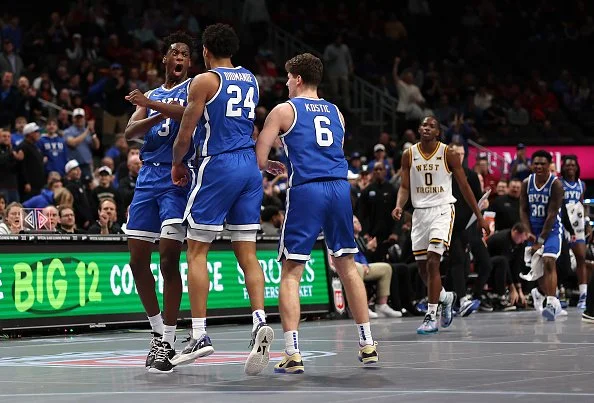
KANSAS CITY, MISSOURI - MARCH 11: AJ Dybantsa #3 of the BYU Cougars reacts with Dominique Diomande #24 and Aleksej Kostić #6 of the BYU Cougars during the second round game of the Men's 2026 Big 12 Tournament against the West Virginia Mountaineers at T-Mobile Center on March 11, 2026 in Kansas City, Missouri. (Photo by Jamie Squire/Getty Images)
"I think these guys have an inner belief in where they are as a team right now," Young said before Selection Sunday. "We're extremely ready. It makes me feel good because, as I told them in the locker room about two weeks ago — I was honestly not sure."
From not sure to ready. In two weeks. That is the story of this BYU team.
The Defense Nobody Saw Coming — And the Coach Who Built It
On March 12, BYU walked into a second-round matchup against West Virginia and quietly delivered the most important statement of the Cougars' season. Final score: BYU 68, West Virginia 48. The Cougars forced 22 Mountaineer turnovers, held West Virginia to 38% shooting, and surrendered just 0.8 points per possession. In three separate stretches where BYU clamped down and refused to give up a basket, the Cougars outscored West Virginia by a combined 37-10 margin. That isn't a defensive performance — that is a suffocation.
The story behind it begins in a postgame press conference after a statement win over Texas Tech a week earlier. Kevin Young was asked how BYU had turned it around. His answer was disarmingly direct. "We've just got to simplify things and just dumb it down and not try to get cute on defense," Young said. "Just not try to get cute with scheme and this and that, just make it pretty solid and simple for the guys — and just hold them accountable to play a little bit harder, rotate harder, rotate longer, stronger."
That decision — strip it back, trust the athletes, play man-to-man and own your assignment — turned out to be the lever that changed BYU's season.
Young challenged his athletes, getting 6-foot-9 Khadim Mboup and 6-foot-7 Dominique Diomande fired up and engaged in expanded roles. Both had been largely on the periphery for much of the season. The simplified scheme was precisely what unlocked them. Mboup, a redshirt freshman from Senegal who came to BYU through the NBA Academy in Africa, brings rare lateral quickness and length for a player his size — the kind of athlete who makes opposing guards rethink their shot before they've even started their release. Diomande brings energy, physicality, and an edge that changes the temperature of a game the moment he checks in. Together in Kansas City, the two seldom-used reserves became defensive disruptors — generating steals, igniting fast breaks, and giving the Cougars exactly the kind of momentum plays that make a team dangerous in March.
Rob Wright III put it plainly after Kansas City: "I think we've found our identity as a team. We've got role players stepping up, like Dom and Aleksej making big shots for us, Moo is playing great the last couple games. It's just figuring out who we are as a team."
Who they are, right now, is a team that can lock opponents down. Then came the Houston quarterfinal. Even in defeat — playing their third game in three days, exhausted, running on fumes in the second half — BYU held the No. 2 seed in the conference to 73 points and trailed by just three with two minutes to play. Houston is the program that breaks teams. BYU didn't break.
Young summarized the defensive mindset after the Houston game simply: "We've just challenged our guys to do things stronger, longer, harder, faster, more. That's really it."
For any team with Final Four aspirations that draws BYU in the bracket, that West Virginia game film is required viewing. Forty-eight points. In the Big 12 Tournament. With Mboup and Diomande doing the dirty work that never shows up in a highlight reel.
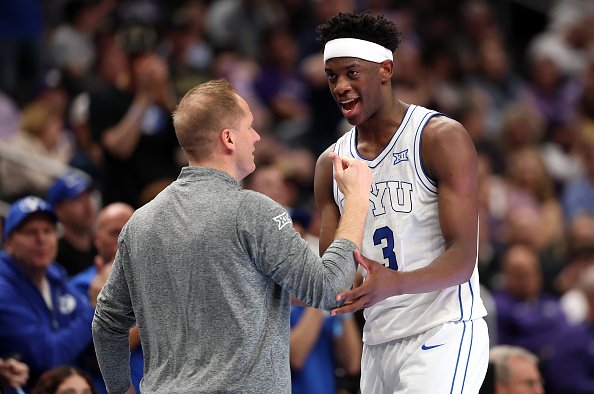
KANSAS CITY, MISSOURI - MARCH 10: AJ Dybantsa #3 of the BYU Cougars talks with head coach Kevin Young as he exits the game during the first round game of the Men's 2026 Big 12 Tournament against the Kansas State Wildcats at T-Mobile Center on March 10, 2026 in Kansas City, Missouri. (Photo by Jamie Squire/Getty Images)
Dybantsa: The Point Forward Evolution
When AJ Dybantsa arrived in Provo as the consensus top recruit in his class, everyone already knew he could score. The 93 points he put up across the Big 12 Tournament — setting a new conference tournament record for a three-game stretch — confirmed what the scouting reports promised. His 40-point eruption against Kansas State in the opening round, scored on 71.4% shooting from the floor, was the kind of performance that sends NBA front offices into emergency meetings on a Wednesday afternoon.
But here is the thing about Dybantsa that the stat sheet only partially captures: he is becoming something more dangerous than a volume scorer. He is becoming a point forward. A floor reader. A player who sees the double team arriving before it gets there.
Every elite defensive game plan in March begins with the same sentence: take the ball out of Dybantsa's hands, send a second body, and make someone else beat you. BYU opponents have been running that script all season. What they keep discovering is that Dybantsa has read the scouting report on himself. When the double comes — and it always comes — he is making the right read, the quick skip pass, the drop to the short roll. He is converting defensive attention into open looks for teammates, and he is doing it with the composure of a player three years deeper in his development than his freshman standing would suggest.
He scored 93 points in three days in Kansas City. He also made the plays that don't show up in those 93 points. That combination is what separates the good ones from the ones who change programs.
Davis and Kostić: The Supporting Cast Has Found Its Confidence
If the single most important development for BYU's postseason ceiling has been Dybantsa's growth as a playmaker, the second most important may be what has happened to Kennard Davis Jr. and Aleksej Kostić from beyond the three-point line.
For much of the season, both players were unquestioned contributors — Davis as a defensive menace and high-motor interior presence, Kostić as a skilled shooter capable of spacing the floor. But spacing the floor and shooting with confidence are two different things. In the Texas Tech home finale, and carrying through the Big 12 Tournament, something visibly shifted. Both players were stepping into their threes earlier, holding their follow-through longer, and releasing with the kind of certainty that comes when a shooter stops thinking and starts trusting. While Kostić hit on 33.3% of his threes in the Big 12 Tournament, Davis made an impressive 45% of his 20 attempts.
This matters enormously in March, because it is the variable that determines whether Dybantsa's playmaking actually punishes defenses or simply resets possessions. A Dybantsa kick-out to a hesitant shooter is a reset. A Dybantsa kick-out to Davis or Kostić right now — confident, catch-and-shoot, no second-guessing — is three points and a timeout. That is the difference between a first weekend exit and a run deep into the second weekend.
Rob Wright continues to provide steady, professional-level point guard play, and the Cougars' collective trust in one another is evident. This is not a team built around one player's heroics. It is a team built around making the right play, with the right personnel, at the right moment. Kevin Young deserves enormous credit for that construction.
BYU Draws the Texas/NC State Play-In Winner in the First Round
BYU has been selected as a No. 6 seed and will face the winner of the First Four play-in game between Texas and NC State on Tuesday, March 17 in Dayton.
Whichever team survives Dayton will be running on fumes and short rest. Texas finished 18-13 in its second year in the SEC under first-year head coach Sean Miller — a program still finding its footing in a new conference, ranking 256th nationally in defensive efficiency. NC State under Will Wade went 20-12 in the ACC, averaging 84 points per game but defending at a level that ranks 225th in the country.
Utah Sports Ink Early Prediction
BYU wins this game, and will hold a comfortable lead for most of the second half.
The play-in survivor arrives having burned an extra game on short rest, facing a BYU team that has rested, scouted, and arrived with the full force of a program that just held Big 12 opponents to 48 and 66 points in back-to-back tournament games. The defensive numbers on both Texas and NC State are an invitation — BYU's simplified, physical, man-to-man scheme is precisely the style that exposes high-octane offenses that haven't faced elite resistance all season.
Dybantsa will get his. But the story of this game will be BYU's defense turning a tired, offensively oriented opponent into a half-court grind neither Texas nor NC State wants any part of. Davis, Kostić and Wright will punish the inevitable defensive collapse on Dybantsa with confident catch-and-shoot threes — and Wright, the steadiest player on the floor, will make defenses pay every time they forget about him. Mboup and Diomande will change the game's temperature the moment they check in.
The Round of 32 game will most likely be the old West Coast Conference foe, Gonzaga, but this BYU team — the one Kevin Young rebuilt in two weeks from the ruins of a demoralizing road trip — is more dangerous than a 6-seed suggests. A Sweet Sixteen is the floor. A deeper run is genuinely on the table.
The Cougars aren't here to fill a bracket spot. They're here to make noise.