

The Invisible Utah Home Hazard
You can’t see it. You can’t smell it. You can’t taste it. And according to the State of Utah, roughly one in three Utah homes that have been tested have elevated levels of it.
Your smoke detectors have batteries. You check the carbon monoxide alarms and lock the doors at night. Maybe you’ve had the furnace inspected and changed the filters more recently than you’d like to admit. But there’s another hazard inside Utah homes that gives almost no indication it’s there: radon.
Radon has no smell, no stain on the wall and no alarm in the middle of the night. According to the Utah Department of Environmental Quality, about one in three Utah homes that have been tested show elevated levels, and tested Utah homes average roughly 5.3 picocuries per liter of air — above the Environmental Protection Agency’s action level of 4 pCi/L. Radon is the second-leading cause of lung cancer nationally and the leading cause among people who don’t smoke.
That makes radon less an obscure environmental issue than a Utah home-health issue. The good news: testing is simple, and when a home tests high, mitigation usually reduces the level dramatically.
What Radon Is
Radon is a naturally occurring radioactive gas formed as uranium in soil and rock breaks down. Outdoors it disperses. Indoors it enters through cracks, joints, crawl spaces and plumbing penetrations around the foundation, drawn in by pressure differences between the soil and the house, where it then accumulates indoors.
The danger isn’t that anyone suddenly feels ill. It’s long-term exposure: inhaled over years, radon and its decay products damage lung tissue and raise cancer risk. Because you can’t see, smell or taste it, testing is the only reliable way to know.
It’s Not Just a Basement Problem
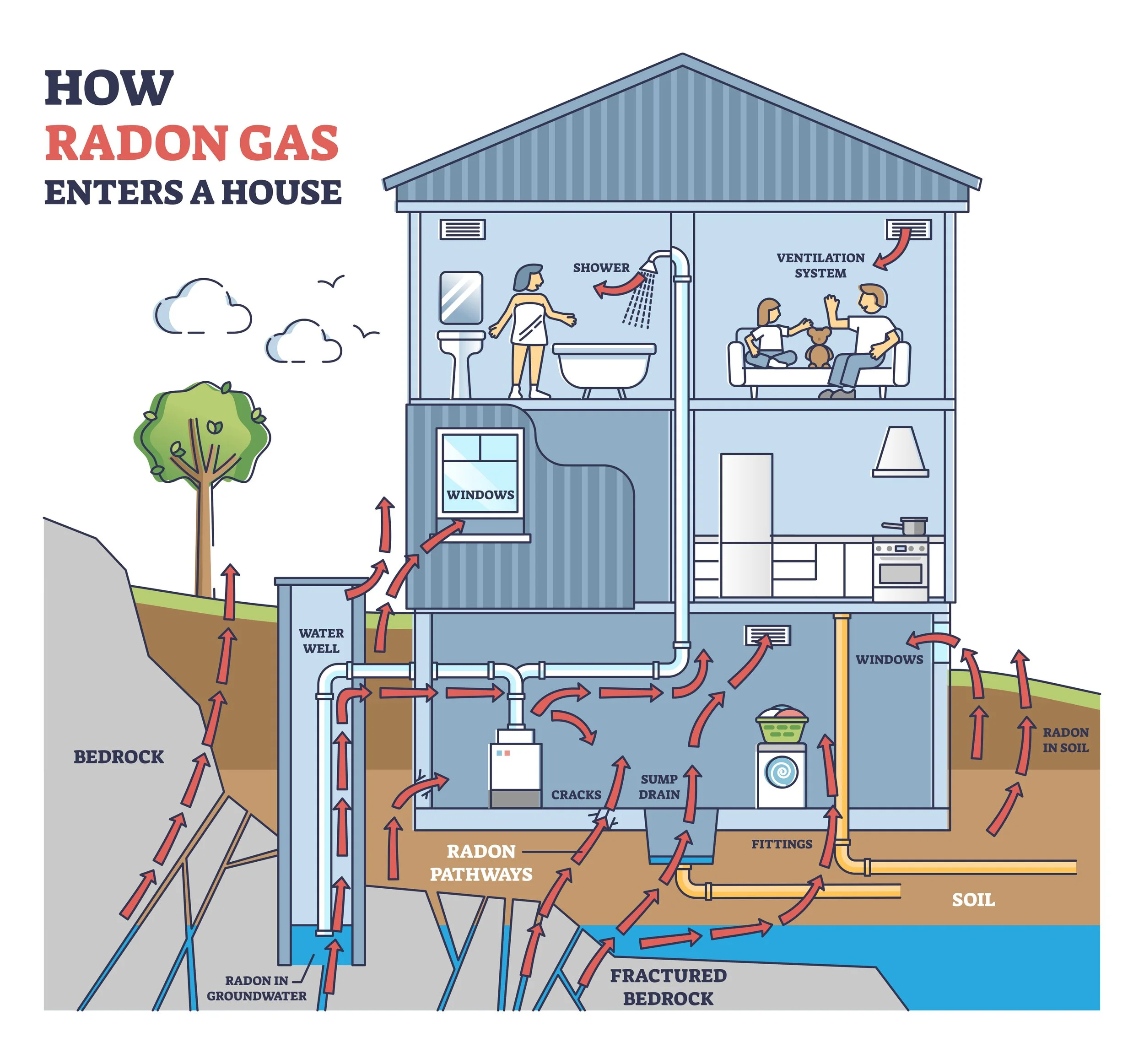
Radon is associated with basements because it enters from the soil beneath the house — but slab homes, crawl spaces, finished and unfinished basements and brand-new construction can all test high. Once radon is inside, normal air movement carries it beyond the lowest level.
When testing to decide whether mitigation is warranted, Utah DEQ recommends the lowest lived-in level: a basement bedroom, family room, office or den, or the basement itself if it’s used regularly. No basement? The main floor may be the right spot. In a real-estate transaction, the EPA recommends testing the lowest level that could be converted to living space, even if it’s unfinished now. If you finish a basement and add bedrooms, test again.
The Number to Know: 4
Results are measured in picocuries per liter, written as pCi/L. At or above 4 pCi/L — the EPA’s action level — the agency recommends taking steps to reduce it.
That isn’t a hard line between safe and dangerous. There is no known risk-free level, and the EPA suggests homeowners consider mitigation for results between 2 and 4 pCi/L as well. For context, the national indoor average is about 1.3 pCi/L and outdoor air about 0.4 pCi/L. Utah DEQ notes most homes with elevated radon can be brought to roughly 2 pCi/L or below.
So a result of 5, 8 or 15 isn’t cause for panic. It’s cause for confirming and acting.
Short-Term vs. Long-Term Tests
A short-term test is the simplest first reading. Utah DEQ’s guidance for many kits calls for roughly 48 to 72 hours in the lowest appropriate living area. Conditions matter: keep windows and exterior doors closed except for normal entry and exit, starting at least 12 hours before the test and continuing throughout. Keep the kit away from drafts, exterior walls and humidity, and out of kitchens and bathrooms. Always follow the instructions that come with the kit.
A long-term test stays in place more than 90 days. Because radon fluctuates with weather and season, it gives a better estimate of average exposure over time. If a short-term result is elevated, follow it with a second short-term test or a long-term test — but don’t sit on a very high result for months waiting for more data.
If You’re Renting
Renters are exposed just as owners are, particularly in basement apartments and ground-floor units. Renters can generally use a test kit, but any permanent change to the property, including mitigation, involves the owner or manager.
If a rental tests high, document the result and notify the landlord or property manager in writing. Ask whether the property has been tested before, whether a mitigation system already exists and what happens next. And ask for the actual number rather than a vague assurance that the place is fine. A number is more useful than a promise.
What Mitigation Actually Does
A high result doesn’t mean the home is unlivable. It means the radon needs a different path out of the ground.
The most common method is active soil depressurization. A contractor uses piping and a continuously operating fan to create suction beneath the house, drawing soil gas out and venting it safely outside, where it disperses — intercepting the radon before it reaches the living space. Designs differ for basements, slabs and crawl spaces, and contractors often seal cracks and openings as part of the work, though sealing alone isn’t considered a complete solution. After installation, the home should be retested to confirm the level actually dropped.
Once you know what a system looks like, you’ll start noticing them around Utah neighborhoods: a pipe running up an exterior wall or routed through the garage, a fan that never shuts off, a small pressure indicator showing it’s working. A system shouldn’t make a buyer nervous. It usually means an owner identified a problem and corrected it — and a house with documented post-mitigation results tells a buyer more than the never-tested house next door.
Don’t Guess
Buying a Utah home? Testing isn’t automatically required in every transaction, so the questions are yours to ask — see the box below. Think about how you’ll use the house, too — the current owners may store boxes in a basement where you plan to put children’s bedrooms.
Two assumptions are worth dropping. First, a neighbor’s result tells you nothing definitive about your house. Soil conditions, foundation construction, air pressure and ventilation all vary from lot to lot; maps and neighborhood averages describe general risk, not what’s happening beneath your foundation. Second, new construction isn’t automatically low. Radon comes from the ground, not from old plumbing or a neglected furnace. If you’re building, ask whether radon-resistant construction techniques are being used, which makes later mitigation easier and cheaper. If you’re buying newly built, ask whether it has actually been tested. “It’s a new neighborhood” is not a radon result.
The Hazard You Have to Look For
Radon doesn’t behave the way we expect danger to behave. Fire creates smoke. A gas leak may produce an odor. Mold discolors a wall. A broken pipe leaves water on the floor. Radon offers none of those warnings. A family can live in a home for years, remodel the basement, move children downstairs and still have no reason to suspect a problem.
Don’t guess based on the age of the home, the absence of a basement, a neighbor’s low result or the fact that everyone in the house feels healthy.
You don’t need to be afraid of your home. You just need to know what’s in it. Test it, know the number, and if it’s high, fix it.
How to Test Your Utah Home
Order a kit. Utah DEQ sells discounted short-term kits, including lab processing, at radon.utah.gov. Kits are also available at most hardware and home-improvement stores. DEQ’s kit has historically run around $11.
Time it right. DEQ suggests starting a short-term test Friday morning and mailing it Monday, which naturally covers the 48-to-72-hour window.
Budget. Utah’s Environmental Public Health Tracking program estimates a typical system costs between $1,000 and $2,500.
Hire certified. If your result is 4 pCi/L or higher, hire a certified professional listed through the National Radon Proficiency Program and the National Radon Safety Board, both linked from radon.utah.gov. Three bids is recommended.
Confirm the fix. Retest after mitigation to confirm the system is working, then periodically to confirm it still is.
Sources: Utah Department of Environmental Quality Indoor Radon Program; U.S. Environmental Protection Agency radon guidance.
This article provides general educational information and is not a substitute for individualized environmental, medical, legal or real-estate advice.