

A Nuclear-Fuel Operation Is Coming to the Wasatch Front. Here's What It Means for Your Neighborhood
A company wants to build a nuclear-fuel operation on the edge of the Salt Lake Valley. Here's what's coming — and the upsides and downsides for the people who live nearby.
By Cal Tebbs | Mountain & Main
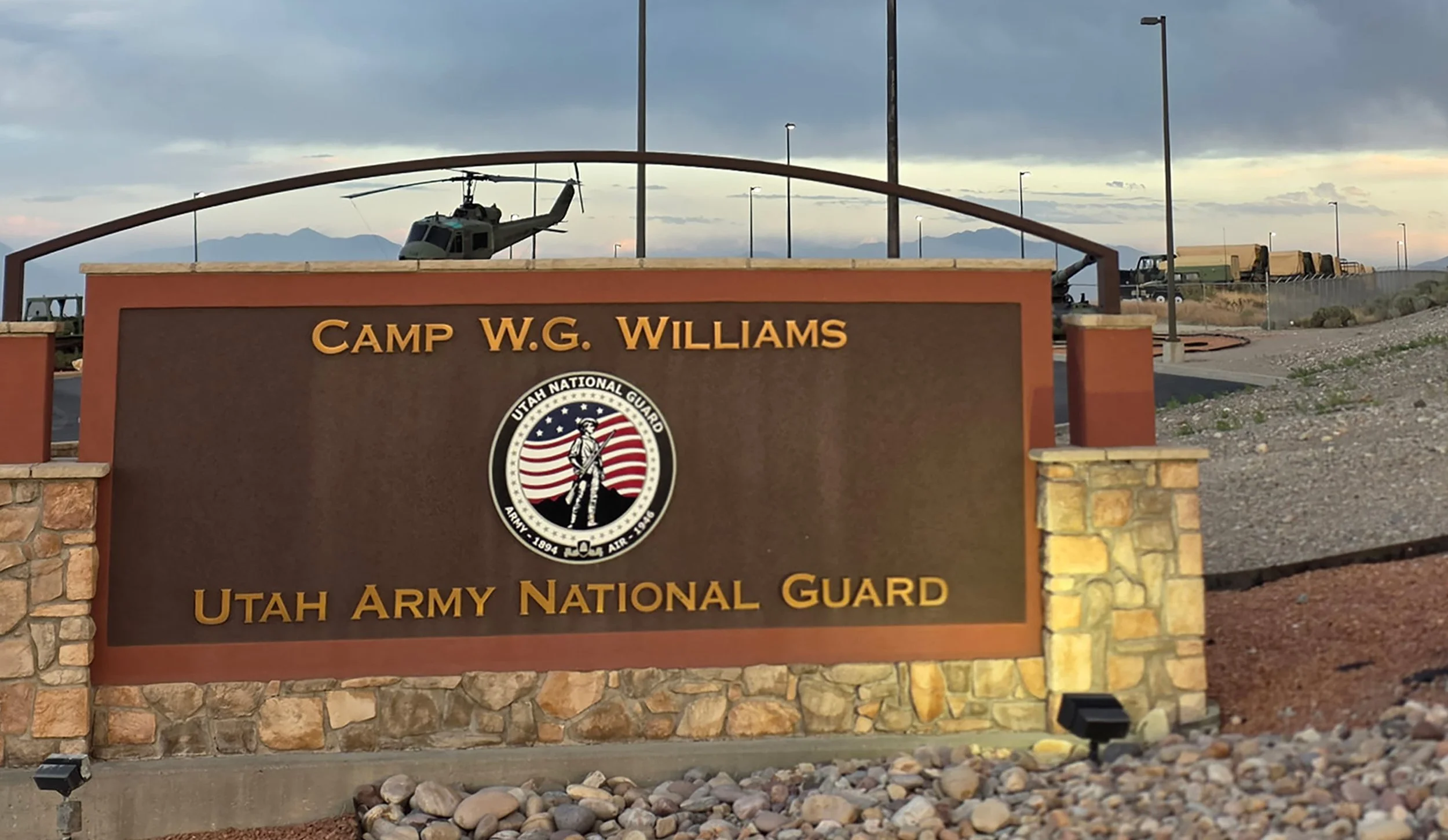
You've probably driven past Camp Williams a hundred times without a thought — the National Guard base on the west bench as you come down the Point of the Mountain. On 400 acres right next to it, the state is clearing ground for a nuclear-fuel operation. If you live in Bluffdale, Herriman, Draper, or anywhere in the south valley, it's happening in your backyard.
Here's what you actually need to know.
THE 30-SECOND VERSION
What: A plant to make nuclear-fuel equipment near Bluffdale — with hopes to eventually enrich uranium on-site.
Where: Camp Williams, near Bluffdale, at the south end of the Salt Lake Valley. (It's a fuel operation — not a reactor.)
Why: Utah wants to double its electricity by 2034 to feed AI data centers and growth. Nuclear is the centerpiece.
The upside: Jobs, a billion-plus in investment, round-the-clock power, and less dependence on Russian uranium.
The catch: The economics are unproven, no plant like this sells power yet, and neighbors are asking why the population center is the right spot.
Your move: There's a required public-comment process before any on-site enrichment could ever happen. You'll get a say.
"Wait — is a reactor being built next to my house?"
No. And this is the confusion worth clearing up first, because two different things got tangled in the headlines.
The thing near you, at Camp Williams, is a fuel operation — not a power plant, and not a reactor. There's no chain reaction firing up next to the freeway. Phase one is a factory that builds the specialized machinery used to enrich uranium. That's industrial manufacturing.
The reactor you may have read about — the minivan-sized one the Air Force flew in on a cargo plane — was switched on for the first time this summer in Emery County, a coal-mining region about three hours south of Salt Lake City. (In the news coverage you'll see it called "going critical." That sounds alarming, but it just means the reactor started running under its own power for the first time — not that anything went wrong.) That's a real milestone, and it's why Utah suddenly became a national nuclear story. But that reactor is far away, down in Emery County — it's not in the Salt Lake Valley, and nothing like it is planned for Camp Williams.
"Okay — so is the Camp Williams part dangerous?"
Here's the middle ground, without the spin from either side.
Phase one — the equipment factory — is about as risky as any heavy-industrial site. The bigger question is phase two: the company has been open that it hopes to eventually enrich uranium there, meaning concentrate it into reactor fuel. That's a bigger deal, and it's why some of your local leaders are pushing back.
To be clear about the fear factor: enrichment for reactor fuel produces low-enriched uranium — power-plant fuel, not weapons material. The newer advanced reactors need fuel enriched to as much as 20% (older reactors use around 5%), and state officials note that what Camp Williams would make stays below the level used for military purposes. But that doesn't make the concerns imaginary. Salt Lake County's mayor has raised three specific ones worth weighing: it would sit in the most densely populated part of the state; there are open environmental and public-health questions; and uranium-technology sites can become security targets in a way Utah has historically avoided. Enrichment can't legally move forward without a federal environmental review built around public input — so it's not a done deal, and it wouldn't be fast.




"So where does Utah actually fit into all this?"
Making nuclear fuel takes a chain of steps, and Utah is reaching for the two ends while skipping the middle. Far to the south, near Blanding, Utah runs the last conventional uranium mill in the country — the step that turns raw ore into a uranium powder called yellowcake. Camp Williams would sit near the opposite end: enrichment, which concentrates uranium into reactor fuel. The steps in between — including turning that powder into a gas — don't happen in Utah at all.
Two things keep this in perspective. Camp Williams starts as a factory that builds the machines used to enrich uranium — it won't be handling uranium fuel itself unless the later, tightly regulated enrichment phase is approved. And the two Utah sites aren't linked: the yellowcake from down south doesn't travel up to Bluffdale. They're two separate footholds on the same chain, not a single Utah pipeline.
"Who's behind it — and when would it happen?"
The company is a California startup called General Matter, operating in Utah through a subsidiary named Utah Energy. Its founder and CEO, Scott Nolan, is a former SpaceX engineer and a partner at Founders Fund — the venture-capital firm co-founded by Peter Thiel, an early backer of SpaceX, Palantir, and Anduril. Founders Fund incubated General Matter and led a roughly $50 million investment in it last year, and Thiel sits on its board. The team is drawn largely from SpaceX, Tesla, Anduril, national laboratories, and the Defense Department.
What it isn't is a homegrown Utah company. There are no deep local roots here — "Utah Energy" is a subsidiary set up for this project. The real Utah ties are on the government side: the National Guard, the state's Military Installation Development Authority, the Office of Energy Development, and Gov. Cox's Operation Gigawatt — along with public support that could include a $5 million loan from the state's energy fund for site work. State officials say the company chose Utah for practical reasons: proximity to nuclear research at the University of Utah, BYU, and Utah State, the military's nuclear mission, and the local workforce.
As for timing, there's no firm opening date. When the project was announced in 2025, state officials described it as the start of a three-to-five-year process, and everything hinges on land preparation, final siting, and regulatory review. The company's one concrete deadline — shipping enriched uranium by the end of the decade — applies to its enrichment plant in Paducah, Kentucky, not to the equipment factory proposed for Camp Williams.
The upside and the catch, side by side
WHAT UTAH GAINS
Power for what's coming. AI data centers need electricity 24/7. Nuclear delivers that in a way wind and solar can't on their own — and the demand is already here.
Jobs and money. The company has floated investing well over a billion dollars, with a manufacturing base on the Wasatch Front.
Energy independence. Roughly a quarter of the enriched uranium in U.S. reactors comes from Russia. Making it here is the whole pitch.
First-mover status. Utah is trying to own the entire chain — from mining to fuel to reactors — instead of importing it.
WHERE THE BET COULD GO WRONG
The math is unproven. A NuScale small-reactor project bought by a Utah public-power group (UAMPS) and planned for Idaho National Laboratory ballooned from under $4 billion to over $9 billion and was canceled in 2023. The most recent conventional U.S. plant took 15 years and $30 billion.
Nobody's selling power yet. The reactors that made news this summer proved they work — not that they can deliver electricity to your home. The federal energy secretary's own guess for first power is 2027 or 2028.
Speed vs. scrutiny. Utah's projects are moving fast partly by using a federal shortcut around the usual multi-year safety-licensing route. Edwin Lyman of the Union of Concerned Scientists has warned Utah communities against hosting experimental reactors before they're fully proven out; supporters call the pace efficiency, critics call it corner-cutting.
Who's deciding. The state agency steering the Camp Williams deal is run by appointed officials, not elected ones — a sticking point for residents who want a vote.
"So what happens next — and do I get a say?"
Yes. The equipment factory can move ahead on its own, but any step toward actually enriching uranium triggers a federal environmental review with mandatory public comment. That's your window. Watch for those notices, watch the state agency's board meetings (they're public), and watch whether a second company quietly signs on to the site — the funding is already set aside for one.
The short version: nuclear isn't a someday-maybe for Utah anymore. It's here, it's on the edge of the valley, and for the first time the tradeoffs — cheaper long-term power against real questions about safety, cost, and who decides — are landing where we live.
DID YOU KNOW?
America has only one conventional uranium mill still running — and it's in Utah.
Most U.S. uranium is mined in Wyoming. But milling — the step that turns raw ore into a concentrated powder called yellowcake — now happens at just one conventional mill left in the country: White Mesa, about six miles south of Blanding in San Juan County. It's running right now, on pace for roughly 1.6 million pounds of uranium concentrate in the first half of 2026, with more Utah mines reopening nearby and a brand-new mill planned in Emery County. It isn't without controversy: the neighboring Ute Mountain Ute community has raised environmental and health concerns for years. So Wyoming leads in digging uranium out of the ground — but Utah holds something almost no other state does: the last working conventional mill, the first stop in turning ore into nuclear fuel.
SOURCES
DOE; World Nuclear News; ANS Nuclear Newswire; POWER Magazine; Deseret News; KUER; KPCW; KSL NewsRadio; Salt Lake Tribune; Utah News Dispatch; Daily Herald; Fox 13; Circle of Blue; Bloomberg; Reuters; U.S. Energy Information Administration.